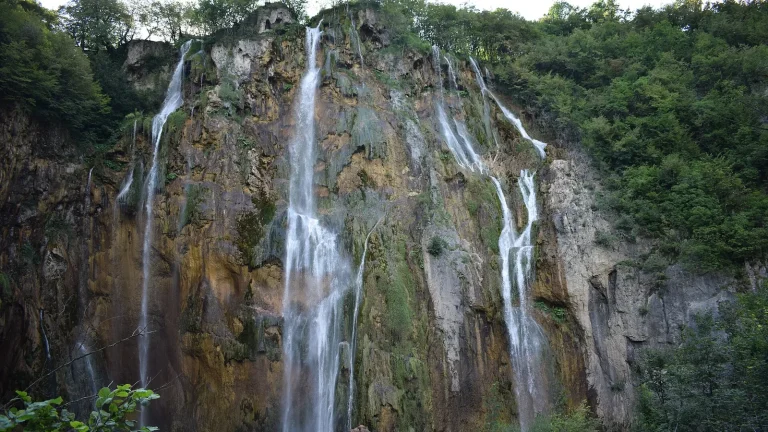
Bosnia and Herzegovina surprises almost everyone I send there, and its rivers are a big part of that. The waterfalls in Bosnia range from the wide turquoise curtain of Kravice in Herzegovina to Štrbački buk on the green Una river and a waterfall that drops right into the middle of a medieval town in Jajce. Most of them are far less crowded than their neighbours in Croatia, and at several you can still swim.
I’ve cooled off at Kravice myself; the rest of this guide is based on the official park pages and price lists, plus tips from other travellers. For each waterfall you’ll find how to get there, the walk, the fee in convertible marks (KM) and whether swimming is allowed. Prices were checked in November 2026.
Waterfalls in Bosnia at a glance
| Waterfall | Region | Height | How to get there | Entry fee* | Swimming? | Best time |
|---|---|---|---|---|---|---|
| Kravice | Ljubuški, Herzegovina | About 28 m | Car, about 1 h from Mostar; tours from Mostar | 20 KM | Yes, at your own risk | May–June, September |
| Kočuša | Veljaci near Ljubuški | About 5 m, 50+ m wide | Car, 10 km from Ljubuški | Included with Kravice ticket | Check before you go | Spring |
| Pliva waterfall | Jajce, central Bosnia | 22 m | Bus from Banja Luka (1.5 h) or Sarajevo (2.5–3 h) | 4–8 KM platform (free viewpoint) | No | Spring, autumn |
| Štrbački buk | Una NP, near Bihać | 24.5 m | Car, last 8 km on unpaved road from Orašac | 8–20 KM | Not at the falls | May–June, September |
| Martin Brod (Milančev buk) | Una NP, near Kulen Vakuf | 54 m drop over 800 m | Car via Kulen Vakuf | Check before you go | Check before you go | Spring, summer |
| Skakavac | Above Nahorevo, Sarajevo | 98 m | Car or minibus to Nahorevo, then walk | Check before you go | No | Spring; frozen in winter |
| Skakavac (Perućica) | Sutjeska NP, near Foča | Over 73 m | Guided tour only, from Tjentište | 10 KM park entry + guided tour | No | April–November |
| Bliha | Near Sanski Most | 56 m | Car, 14 km west of Sanski Most | Check before you go | Check before you go | Spring |
*Adult price from the official price lists (checked November 2026). Una National Park prices depend on the season.
1. Kravice waterfalls
Kravice is the waterfall everyone pictures when they think of Bosnia: the river spills over a horseshoe of travertine about 28 m high and 120 m wide into a turquoise lake. I’ve cooled off here myself, and the photo at the top of this post is from a little boat ride right up to the falls. On a hot Herzegovina day, it’s pure magic.
- How to get there: Kravice is about 40 km from Mostar (about an hour by car) and 10 km from Ljubuški. It’s about 2 hours from Dubrovnik and 3 hours from Sarajevo. There’s no public transport to the falls, so without a car take a day tour from Mostar.
- The walk: from the car park it’s 15–25 minutes down: steps (about 15 min), a gentler sloped path that works for pushchairs and wheelchairs (20–25 min) or a little tourist train in summer.
- Fee: adults 20 KM all year, BiH residents 10 KM, under-7s free (checked November 2026). The ticket also covers the Kočuša waterfall and the Humac monastery museum. Parking is 3 KM per started hour or 6 KM for the day.
- Opening hours: from 7:00 every day, closing at 17:00 in winter, 18:00 in March and April, 20:00 in May, 22:00 from June to September and 19:00 in October.
- Swimming: yes, at your own risk. Dogs aren’t allowed in the bathing areas.
- Best time: late spring for the most water; travellers who come in October find it quiet but with lower flow. In summer, arrive close to opening time.
The cafés at the bottom are seasonal and mostly take cash, so bring some marks with you. Kravice pairs perfectly with Blagaj and a night in Mostar; see my one day in Mostar guide. Current prices and hours are on the official Kravice website.
2. Kočuša waterfall
Kočuša is Kravice’s little sister, on the Trebižat river system in the village of Veljaci about 10 km from Ljubuški. It’s only about 5 m high but more than 50 m wide, so it looks like a giant natural water slide.
- How to get there: by car from Ljubuški; it’s an easy add-on on the same day as Kravice.
- Fee: included in your Kravice ticket (checked November 2026), so keep it.
- Swimming: the official pages don’t say; check before you go.
- Best time: spring, when the rivers carry the most water.
3. Pliva waterfall in Jajce
Few towns in Europe have a waterfall in the middle of them. In Jajce, the Pliva river drops 22 m into the Vrbas at the edge of the old walled town. It used to be about 30 m, but an earthquake and war-time flooding upstream changed it. The old town and the waterfall are together on UNESCO’s tentative list.
- How to get there: buses take about 1.5 hours from Banja Luka and 2.5–3 hours from Sarajevo.
- The walk: 30–40 minutes is enough for the official viewing platform. For a free view, cross the green chain bridge, walk about 100 m east along the road and take the steep path on the left down to a covered lookout.
- Fee: the platform cost 4 KM in winter and 8 KM from May to September (including the Ethno Museum and Mithraeum) when it was last listed; check before you go.
- Swimming: no, it’s a viewing waterfall. In August there are cliff-jumping events that draw big crowds.
- Tip: about 4 km upstream you’ll find the wooden Pliva watermills and the Pliva lakes, a lovely walk or short taxi ride from town.
4. Štrbački buk, Una National Park
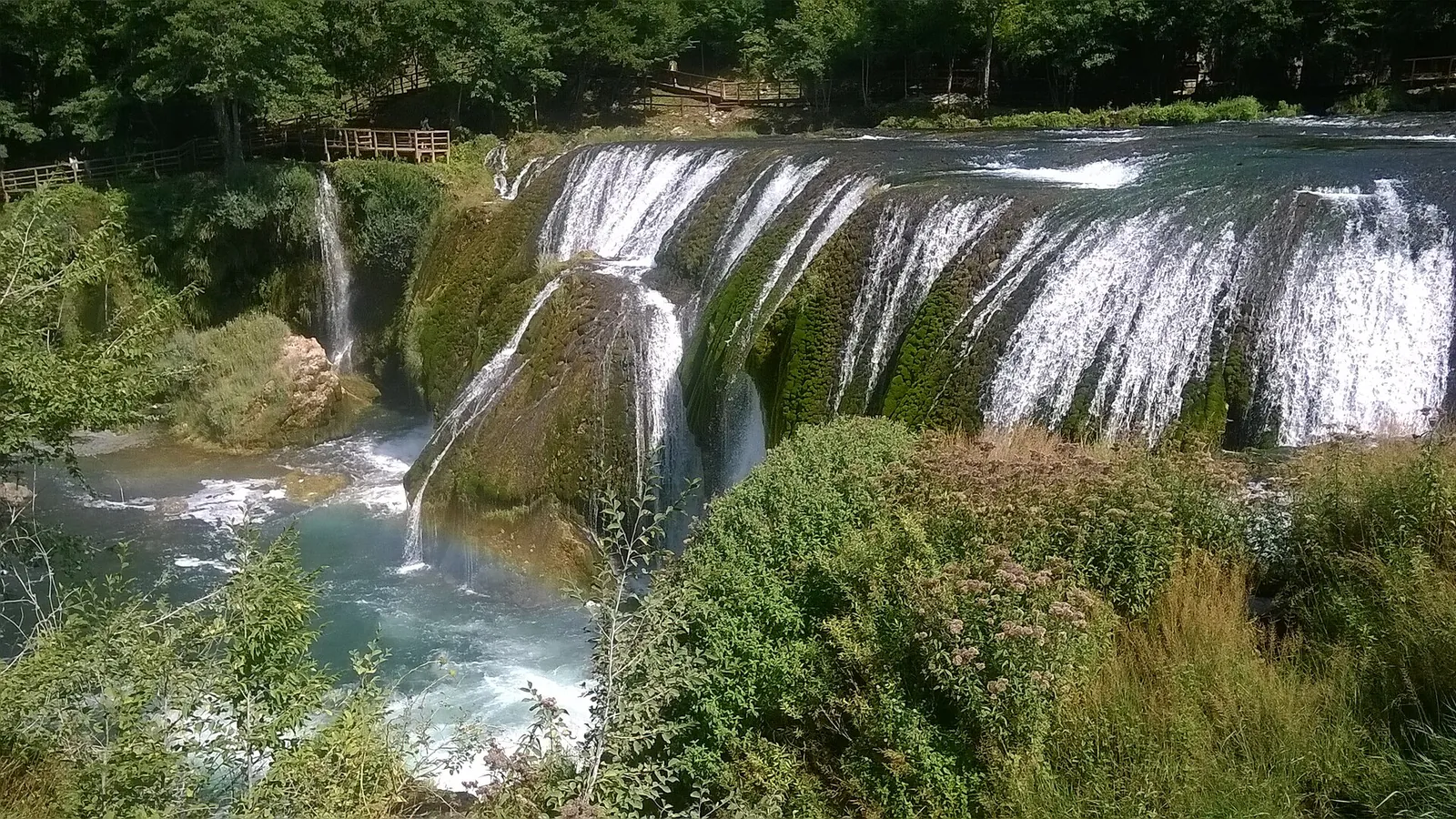
Štrbački buk is the star of Una National Park, which covers 20,000 hectares of the Una river valley. The water falls 24.5 m over three travertine steps, the biggest a sheer 18 m drop, across a front about 40 m wide. Wooden stairs with handrails and a series of viewing platforms take you around it.
- How to get there: the nearest town is Bihać. Turn off at Orašac on the road to Kulen Vakuf; the last 8 km is a graded but potholed gravel road to Entrance 3. Drive slowly.
- Fee (2026): adults 8 KM in January, February and December, 12 KM in March, April and November, 16 KM in May, June, September and October and 20 KM in July and August; children 7–14 pay 6–12 KM, and under-7s are free (checked November 2026).
- Swimming: not at the falls themselves, but there are swimming spots along the river on the way in.
- Rafting: the Štrbački buk–Lohovo stretch is one of the park’s rafting routes, with licensed operators only; the park fee for it is 12–20 KM on top of the operator’s price.
- Best time: May, June or September for strong water and fewer people.
Tickets and rafting rules are on the Una National Park website.
Štrbački buk is just across the border from Croatia, so it’s an easy add-on to a Plitvice trip; see my guide to the best waterfalls in Croatia.
5. Martin Brod and Milančev buk
Further upstream in the same national park, the village of Martin Brod sits on a maze of cascades. Milančev buk is the largest group of waterfalls in the park: a chain of falls about 800 m long with a total drop of 54 m. It’s more spread out than Štrbački buk, with the Lučica picnic area nearby.
- How to get there: by car via Kulen Vakuf, the biggest village in the park, with the Ostrovica fortress above it.
- Fee: a combined Štrbački buk + Milančev buk adult ticket costs 10–25 KM depending on the season (checked November 2026); the separate Martin Brod price wasn’t clear on the price list, so check before you go.
- Rafting and kayaking: the Martin Brod–Kulen Vakuf stretch is an official route (park fee 6–12 KM).
- Tip: do Štrbački buk in the morning and Martin Brod after lunch for a full Una day.
6. Skakavac waterfall near Sarajevo
At 98 m, Skakavac is one of the tallest waterfalls in the Balkans, and it’s only about 12 km northeast of Sarajevo. It falls below Bukovik peak above the village of Nahorevo, inside a protected nature monument. In winter it can freeze into ice sculptures.
- How to get there: by car, drive past the Zetra hall up to Nahorevo and on to the entrance barrier; from there it’s about 1 km on foot. Parking is limited. Without a car, an hourly minibus runs from Sutjeska Street to Nahorevo, but then you walk about 8 km in total to the falls.
- Fee: the protected area’s page didn’t list a price; check before you go.
- Swimming: no.
- Tip: combine it with a day in Sarajevo. Wear proper walking shoes.
7. Skakavac in Perućica, Sutjeska National Park
Bosnia’s other Skakavac is wilder and much harder to reach. It drops over 73 m off a cliff inside the Perućica primeval forest in Sutjeska National Park. The forest has the highest level of protection, so you can only visit with authorised park staff.
- How to get there: the park’s guided tour starts in the morning in Tjentište (Hotel Mladost or Restaurant Komlen) with a 40–50 minute off-road drive to Dragoš sedlo, at 1,260 m.
- The walk: about 9 km return, steep most of the way; about 3 hours of hiking, 4–5 hours in total.
- Fee: the tour costs €100 per person including a licensed guide, plus 10 KM park entry (checked November 2026).
- Best time: April to November; bring mosquito repellent in May and June.
- Tip: the viewpoints on the drive in also look out over the forest and the waterfall. The nearest town is Foča.
8. Bliha waterfall near Sanski Most
Bliha is a 56 m single drop near the village of Fajtovci, about 14 km west of Sanski Most in northwest Bosnia. It has been a protected natural monument since 1965 and sees far fewer visitors than the Una falls.
- How to get there: by car from Sanski Most; I couldn’t find official directions, so check the route before you go.
- Fee and swimming: no official information online; check before you go.
- Best time: spring, when the river carries the most water.
How to plan a waterfall road trip in Bosnia
The waterfalls are spread around the country, so it’s easiest to group them by region:
- Herzegovina (1 day): Mostar → Kravice in the morning → Kočuša → back via Blagaj for the evening.
- Una valley (1–2 days): Bihać → Štrbački buk → Martin Brod and Kulen Vakuf. Add Bliha near Sanski Most if you have a car.
- Central Bosnia (half a day): Jajce and the Pliva lakes, on the way between Banja Luka and Sarajevo.
- Sarajevo and the east: Skakavac as a half-day trip from Sarajevo, and the Perućica tour from Tjentište near Foča.
A car makes all of this much easier, as several falls have no public transport. For more ideas, see my Bosnia and Herzegovina travel guide.
Best time to see waterfalls in Bosnia
Bosnia’s waterfalls are fed by rain and snowmelt, so they are at their fullest in spring. My favourite windows are May to early June and September to early October: the falls still have water, it’s warm but not scorching and the big sights are calm. July and August are the best months for swimming at Kravice and on the Una, but also the busiest, and Una tickets are at their highest. In winter, Skakavac above Sarajevo can freeze, and Kravice closes at 17:00.
What to pack
- Cash in convertible marks (KM) for parking, cafés and boat rides
- Swimwear, a towel and water shoes or sandals for Kravice
- Hiking shoes for Skakavac and Perućica
- Mosquito repellent in late spring and summer
- Your passport if you’re coming from Croatia
Safety tips
- Swimming at Kravice is officially at your own risk
- Watch out for slippery travertine and mossy rocks around all the falls
- Kravice warns of landslides; stay on the paths
- Only raft the Una with licensed operators, as the park requires
- Never enter Perućica without the park’s guides
- After heavy rain, rivers can rise quickly; stay back from the edges
Insider tips from travellers
- At Kravice, arrive near the 7:00 opening time in summer, when the crowds are smallest.
- Bring cash: the food stalls at Kravice are seasonal and mostly cash-only.
- In Jajce, the free lookout across the chain bridge gives a better view than the paid platform.
- Una tickets are cheapest outside July and August: 8–16 KM instead of 20 KM.
More waterfall guides: the best waterfalls in Croatia and the best waterfalls in Serbia.
Bosnia waterfalls FAQ
What is the most famous waterfall in Bosnia?
Kravice near Ljubuški in Herzegovina. It is about 28 m high and 120 m wide, and you can swim in the lake below at your own risk.
How much does Kravice cost?
Adult tickets are 20 KM all year, 10 KM for BiH residents, and children under 7 go free. Parking is 3 KM per hour or 6 KM per day. Checked November 2026.
Can you swim at waterfalls in Bosnia?
Yes, at Kravice (at your own risk) and at several river spots along the Una. Swimming is not possible at the Pliva waterfall in Jajce or at either Skakavac.
How do I get to Kravice from Mostar?
Kravice is about 40 km from Mostar, about an hour by car. There is no public transport, so take a car or a day tour from Mostar.
What is the tallest waterfall in Bosnia?
Skakavac above Nahorevo near Sarajevo, at 98 m. Skakavac in Perućica, Sutjeska National Park, is over 73 m.
How much is the ticket for Štrbački buk?
Adult tickets in 2026 range from 8 KM in winter to 20 KM in July and August. Children under 7 are free.
When is the best time to visit Bosnia's waterfalls?
May to early June and September to early October, when there is still plenty of water and fewer crowds. July and August are best for swimming but busiest.

Written by
Miki Kokica
Travel blogger behind One Day Itinerary. I test every route myself and share honest, practical guides so you can plan better trips in less time.
Work with me Instagram