

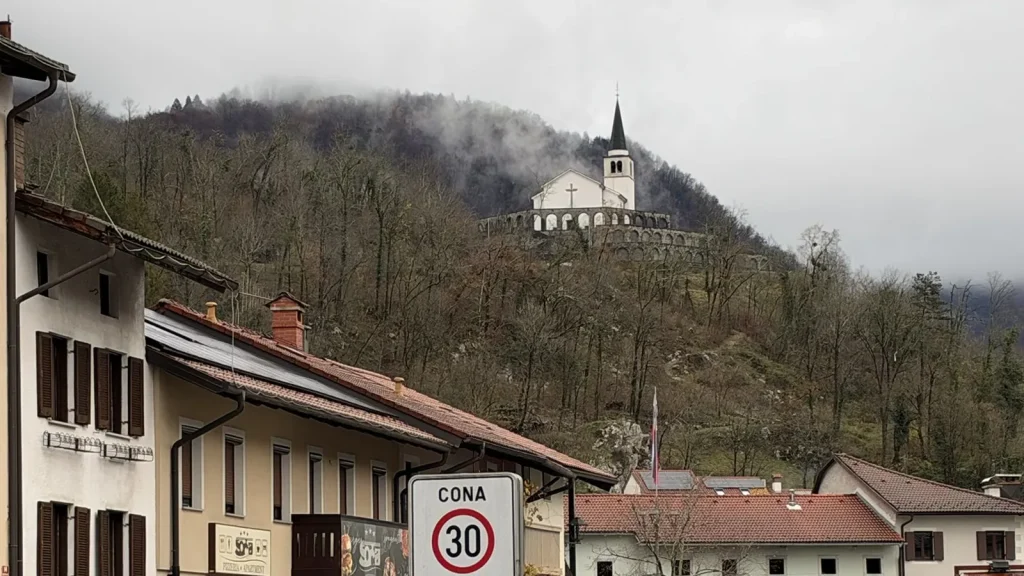
Kobarid is one of those places you drive through on the way to the Soča River and only later realise you should have stopped. It’s a small market town in western Slovenia, a few kilometres from the Italian border, with a church-topped hill above the main square, a world-famous First World War museum, a three-Michelin-star restaurant just outside town and some of the best comfort food I’ve had in the Alps.
We came up from Pula in Istria at the end of November with our five-month-old baby. The drive took us about three hours, including a feeding stop. It was properly cold, sleet was coming down for most of the day and the mountain tops around the valley had their first snow. Honestly? It was still a great day. This guide covers what we did, what I’d add with more time or better weather, where to eat, where to sleep and everything practical you need for 2027.
Kobarid in one day: the quick answer
- Morning: the Kobarid Museum (allow about 1.5 hours), then the old FIAT truck and the Walk of Peace centre next door.
- Lunch: frika and grilled polenta at Lipa bar, with a hot chocolate if it’s cold.
- Afternoon: walk up to the Italian Charnel House and the Church of St. Anthony for the view, then continue on the Kobarid Historical Trail to the Kozjak Waterfall if you have the time and the legs.
- Evening: dinner at Kotlar or Topli Val in town, or at Hiša Franko if you managed to book.
Why Kobarid is worth a day
Italians know Kobarid as Caporetto, and the name still carries weight there. In October 1917 the Austro-Hungarian and German armies broke through the Italian lines here in the Battle of Caporetto, also called the 12th Battle of the Isonzo. Ernest Hemingway wrote about the Italian retreat in A Farewell to Arms, and a young Erwin Rommel fought in the hills right above town. Slovenians call it the “Miracle of Kobarid”.
That history is everywhere, but Kobarid doesn’t feel like an open-air memorial. It’s a lived-in little town of pastel houses, cafés and inns, sitting in a green valley under Mount Krn, with the emerald Soča a few minutes’ walk away. One day is enough to see the town properly. Two days let you add the waterfall, the river and a long dinner without rushing.
Getting to Kobarid from Istria (and elsewhere)
From Pula it took us roughly three hours by car, and with a baby on board I’d plan for a bit more. If you’re staying anywhere in Istria, say Rovinj or one of the beach towns around Pula, Kobarid makes a surprisingly doable long day trip or, better, a one-night escape to the mountains.
- By car: the easiest option by far. If you use Slovenian motorways you need the e-vignette, which you buy online before you drive on them. The last part of the route follows the Soča valley on a normal two-lane road, so take it slowly in rain or snow.
- Parking: we found free spots near the centre without any trouble in late November. In July and August it’s a different story, so arrive early.
- By bus: there are regional buses through the valley from Tolmin, Bovec and Nova Gorica, but timetables are thin outside summer. For a one-day visit, a car makes life a lot easier.
- From Ljubljana: organised Soča valley day trips run from the capital and usually stop near Kobarid (see the tours below).
Travelling with a baby: how it went
Our little one was five months old, so the day was built around naps and feeds rather than a strict schedule. A few things made it easy. The town centre is compact and mostly flat, the museum is a warm indoor stop, and the cafés were happy to let us take our time. The walk up to the Charnel House is on a paved road, so a sturdy stroller or a baby carrier both work. The trail to the Kozjak Waterfall is a different matter: roots, rocks and wet wooden walkways mean a carrier only. If you’re planning more city trips with a little one, our Prague with a baby guide has more of what we’ve learned.
Morning: the Kobarid Museum
Start at the Kobarid Museum (Kobariški muzej) on Gregorčičeva ulica. It tells the story of the Isonzo Front, the 29 months of fighting along the Soča between 1915 and 1917, through photos, letters, weapons, models of the mountain battlefields and some very personal objects left behind by soldiers on all sides. It’s a museum about people rather than generals, which is probably why it won the Council of Europe Museum Prize. Even if you’re not into military history, give it an hour and a half.
- Tickets: €8 for adults, €6 for pensioners and students, €4 for schoolchildren, €20 for a family ticket. Entry is free with the Julian Alps: Soča Valley card.
- Opening hours: open every day. In the winter season the museum has been open 10:00–17:00, with longer hours from spring and into summer. Check the official museum website before you go.
- Guided tours: the museum also runs guided walks to the Charnel House and along the Kobarid Historical Trail for groups.
The FIAT 15 TER and the Walk of Peace centre
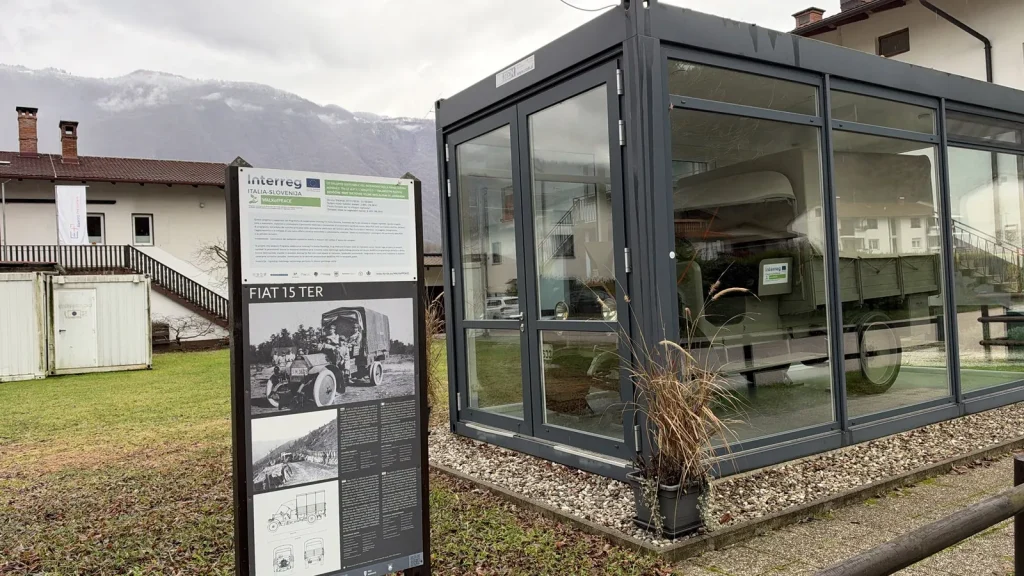
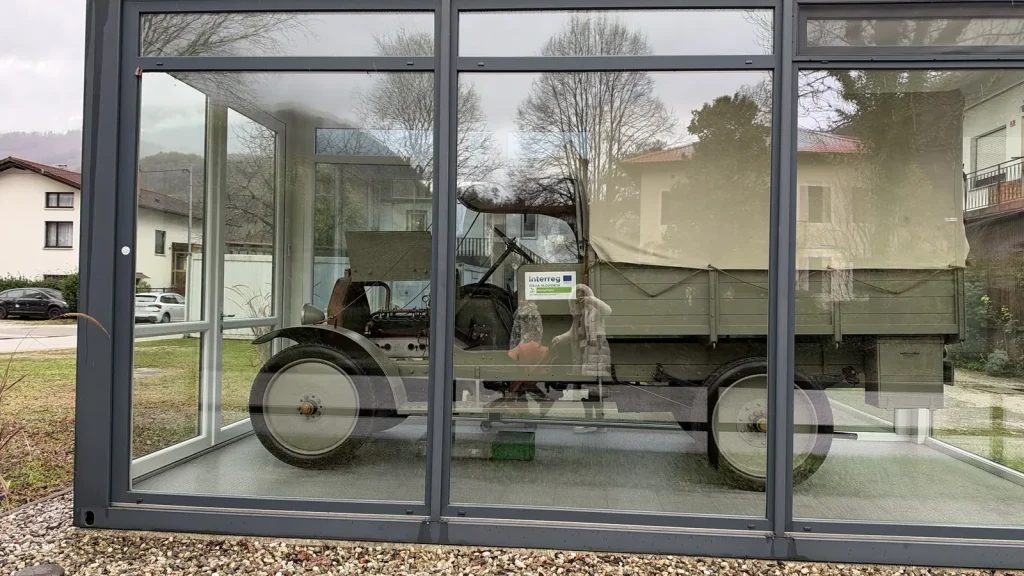
Right next to the museum there’s a glass pavilion with a beautifully restored FIAT 15 TER, an Italian army truck from 1911. Locals call it “Kadorna”, after Luigi Cadorna, the Italian general who commanded on the Isonzo Front. The Kobarid volunteer fire brigade got the truck after the Second World War and still owns it. It was restored as part of the Italy–Slovenia WALKofPEACE project and has stood in this pavilion since 2020. It’s a quick stop, but a fun one, and the information board next to it has old photos of the truck in action.
The Walk of Peace visitor centre is also on Gregorčičeva ulica. The Walk of Peace is a long-distance trail of roughly 320 km that follows the old front line from the Alps to the Adriatic, linking outdoor museums, trenches and memorials. You don’t need to hike any of it to enjoy Kobarid, but the centre is a good place to pick up maps and ideas if you’ll be in the valley for longer.
A short walk around the centre
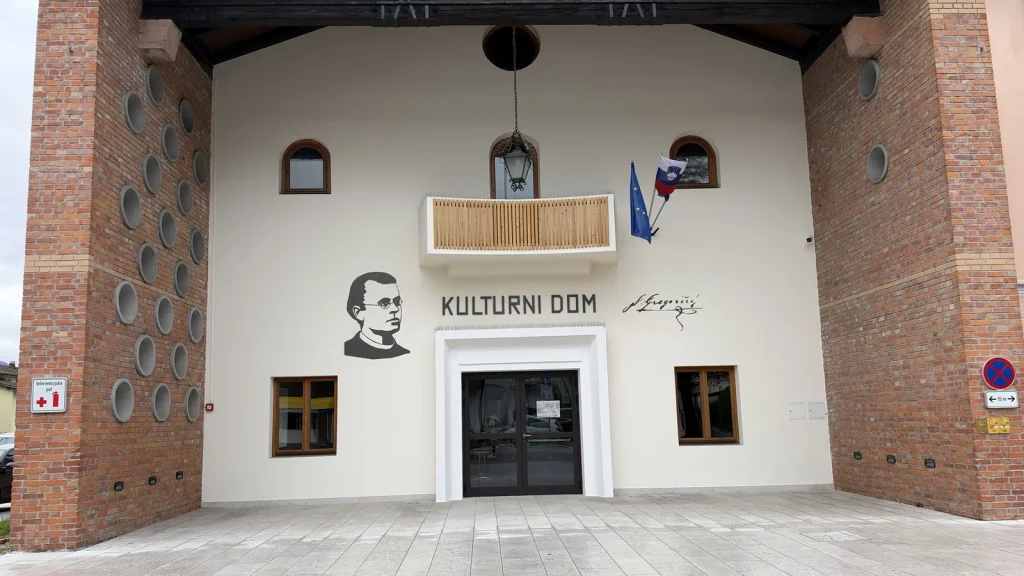
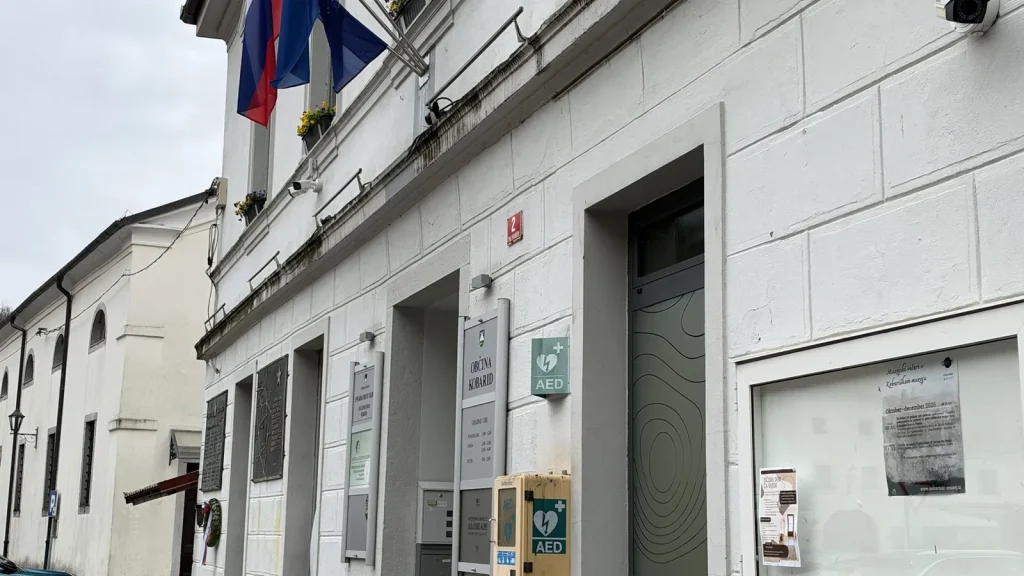
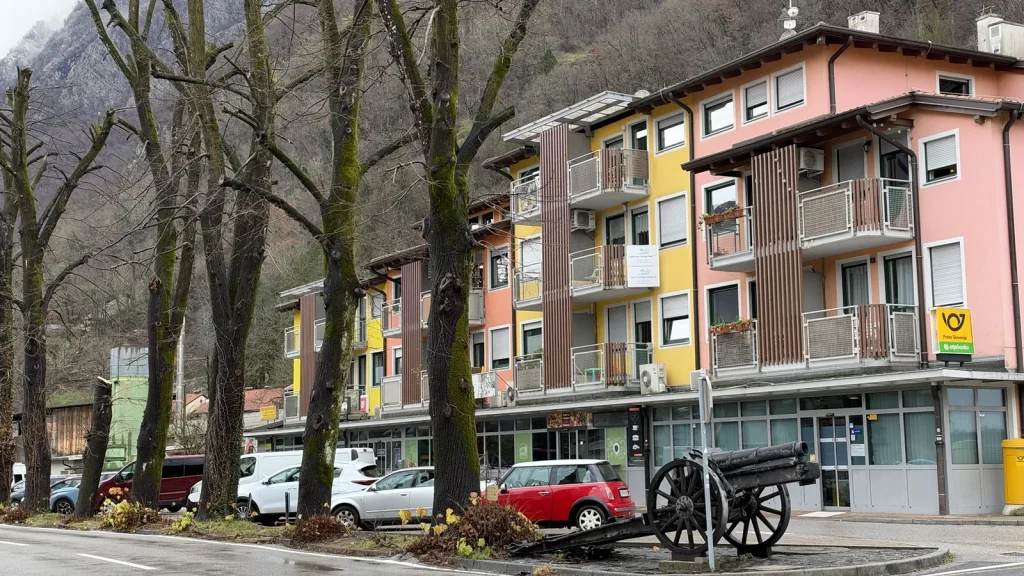
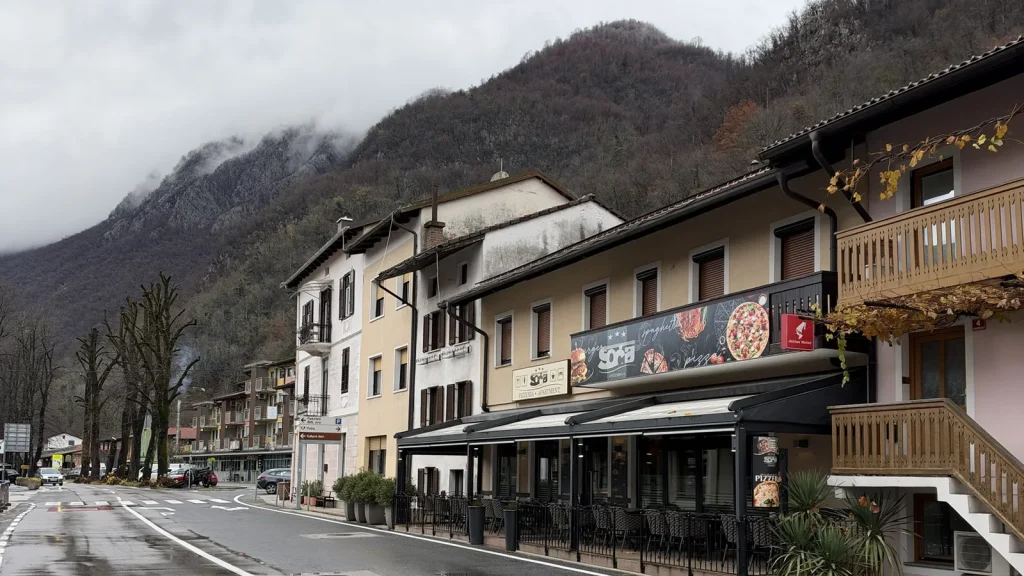
The old centre takes 20–30 minutes to wander. Look out for the Kulturni dom, the cultural centre with the portrait and signature of the poet Simon Gregorčič on its façade. He was born in the hills just above Kobarid, and you’ll see his name all over town. The town hall (Občina Kobarid) on the main square has memorial plaques on its wall, and across the road from the post office an old First World War cannon sits among the plane trees, in front of a row of bright yellow and pink apartment buildings.
Lunch: hot chocolate and frika at Lipa bar
By midday the sleet had soaked through everything, so we ducked into Lipa bar, a casual grill restaurant in the centre. I ordered a hot chocolate and it turned out to be the best one I’ve had in a long time: thick, properly chocolatey and not too sweet. Just what you need when your fingers have stopped working.
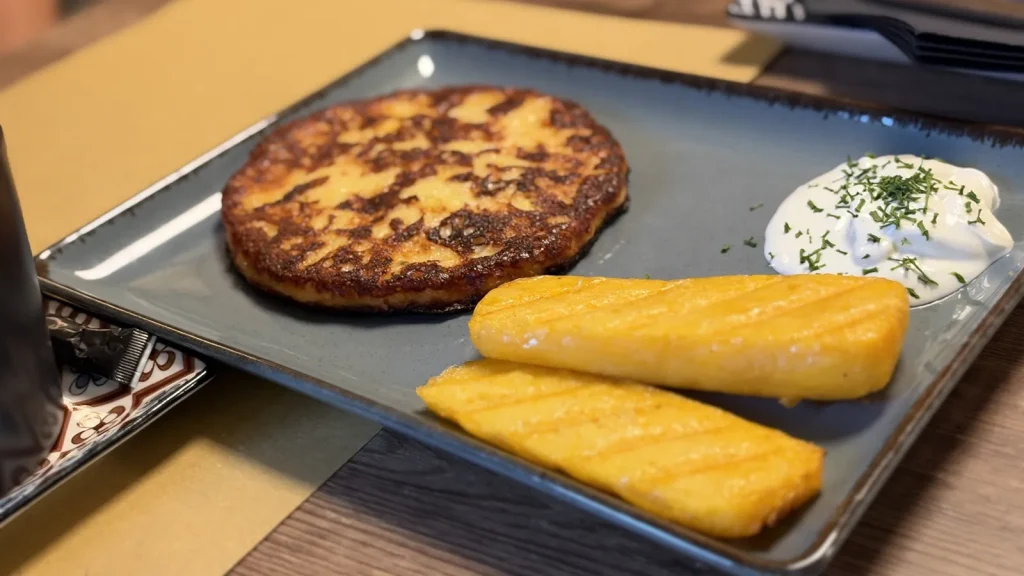
Then came the house speciality: frika with grilled polenta. If you’ve never heard of it, frika is the classic dish of the Soča valley, a golden, crispy patty of potatoes and local Tolminc cheese fried in a pan until the cheese forms a crust. It was originally shepherd food, and you can tell, because it keeps you going for hours. At Lipa you can choose your frika: the classic one with just cheese, one with pršut (prosciutto), or one with herbs and spices. Ours came with two thick slices of grilled polenta and a spoonful of sour cream with chives. Simple, filling and very good.
Lipa also does burgers, ribs, ćevapčići and other grilled dishes, and it has a big terrace for warmer days. Leave room for kobariški štruklji if you see them anywhere in town. They’re Kobarid’s own sweet rolled dumplings, filled with walnuts and raisins, and the town even has a food festival built around them.
Afternoon: up to the Italian Charnel House for the view
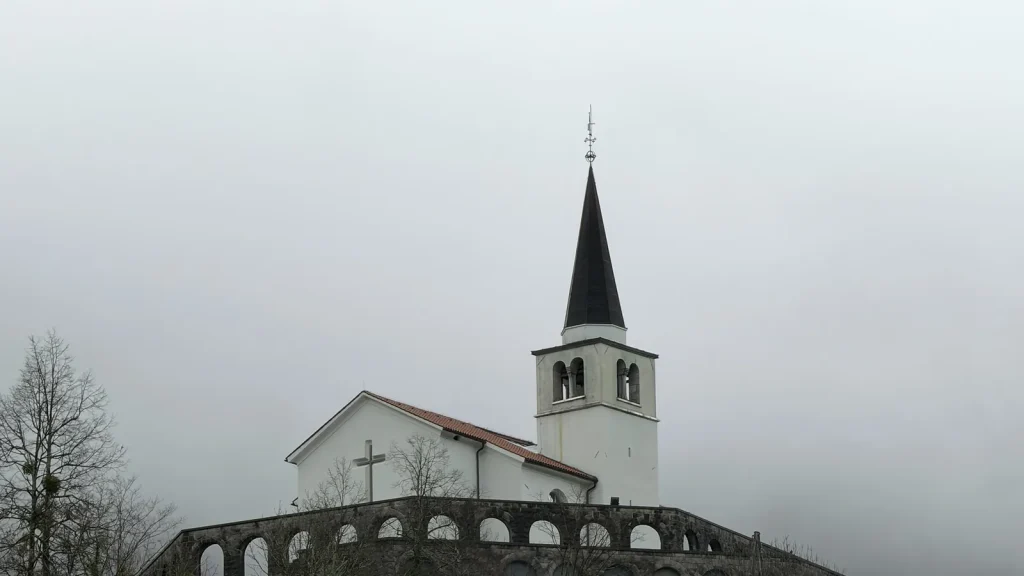
After lunch, walk up the hill you’ve been looking at all morning. On top of Gradič hill stands the Italian Charnel House (Italijanska kostnica), built around the much older Church of St. Anthony, which was consecrated in 1696. From below, with its rings of stone arches, it looks a lot like a fortress. The memorial was opened in 1938 and holds the remains of 7,014 Italian soldiers, known and unknown, who were brought here from military cemeteries around the valley. The building rises in three octagonal terraces that get smaller towards the top, and the walls are lined with their names.
The road up is lined with the Stations of the Cross. On foot it takes around 15–20 minutes from the main square, and you can also drive up. At the top you get the best view in Kobarid: the red roofs of the town, the Soča valley, Mount Krn and the long ridge of Stol on the other side. Even on our grey, sleety afternoon it was beautiful, with clouds drifting through the valley below us. Be quiet and respectful up there, it’s a war grave.
Keep going: the Kobarid Historical Trail
If the weather is on your side, the Charnel House is the first stop on the Kobarid Historical Trail (Kobariška zgodovinska pot), a circular hike of about 5 km (around 7 km if you include every detour) that starts at the museum. Plan on 3–4 hours with stops. Along the way you pass:
- Tonocov grad, a rocky hill that was settled on and off from the Copper Age to the Middle Ages. In late antiquity it had more than twenty houses and several churches, and you can still see their foundations.
- The Italian line of defence, a stretch of First World War trenches and caverns above the river.
- The Soča gorge, where the river squeezes between white rocks and turns that impossible emerald colour.
- The Kozjak Waterfall, the highlight for most people (more below).
- Napoleon Bridge, an 18th-century crossing over the Soča that takes its name from Napoleon’s troops, who marched through the valley.
With a five-month-old and sleet coming down, we kept it to the town and the hill this time, and the waterfall is first on our list for a summer return. Trails get slippery when wet, so wear proper shoes.
The Kozjak Waterfall
The Kozjak Waterfall (Slap Kozjak) is a 15-metre fall that drops into a dark, moss-covered rock chamber with a green pool at the bottom. It’s one of the most photographed spots in Slovenia. From the car park near Napoleon Bridge it’s an easy walk of about half an hour, past the smaller 8-metre Mali Kozjak waterfall. You can also walk all the way from the centre of Kobarid in about an hour each way.
- Entrance fee: €5 for adults, €3 for children aged 7–14, €4 for students and seniors, €12 for families. Free with the Julian Alps: Soča Valley card.
- Season: the entrance point is staffed from April to the end of October. Outside the season the path isn’t maintained in the same way, so take extra care after rain or snow.
- Swimming: not in the waterfall pool. Swim in the Soča instead, if you’re brave enough for the cold.
If you’re collecting waterfalls, take a look at our list of the best waterfalls in Croatia for your way back south.
Where to eat in Kobarid
For a town of around a thousand people, Kobarid has a ridiculous amount of good food. It likes to call itself the culinary capital of the Soča valley, and for once that’s not just marketing.
Hiša Franko (special occasion)
About 3 km west of town, Hiša Franko is the reason many people come to Kobarid at all. Chef Ana Roš, once named the world’s best female chef, earned the restaurant three Michelin stars and a green star in 2023, and it has been on The World’s 50 Best Restaurants list since 2017. Expect a long tasting menu built on wild herbs, river trout, local cheese and fermented flavours from the valley. You’ll need to book well ahead. It serves lunch and dinner from Wednesday to Sunday and takes a winter break, usually from early January to mid-February, so check dates before you plan a trip around it.
Restavracija Kotlar
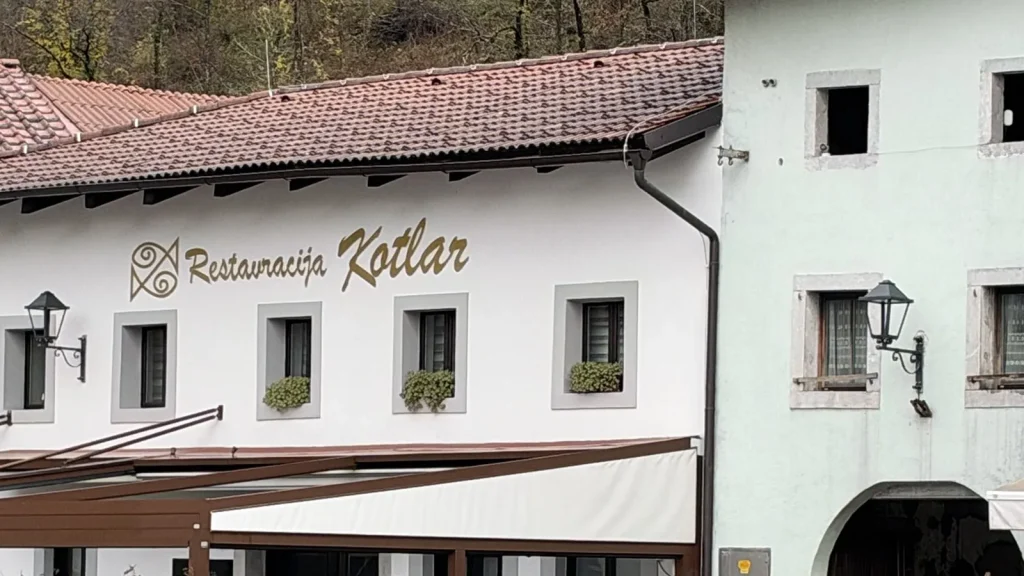
On Trg svobode, the main square, Kotlar is the classic sit-down restaurant in town and is especially known for fish and seafood, which sounds strange in the Alps until you remember the Adriatic is only a couple of hours away. Good for a proper dinner without the Hiša Franko price tag. Check the opening days before you go, since many restaurants here close one or two days a week, especially off-season.
Topli Val at Hotel Hvala
The Hvala family has been cooking in Kobarid for decades, and their restaurant Topli Val, inside Hotel Hvala, is another local favourite for seafood and Soča trout. Very handy if you’re staying at the hotel.
Lipa bar (casual and cosy)
Our pick for a relaxed lunch: frika with your choice of cheese, pršut or spices, grilled polenta, burgers and that hot chocolate. Fair prices, friendly service and no need to book.
More options
- Hiša Polonka: a traditional inn known for local dishes and kobariški štruklji. Check that it’s open before you go, as some listings have shown it as temporarily closed.
- Pizzeria Soča: pizza, pasta and burgers on the main road, with a big covered terrace. Easy with kids.
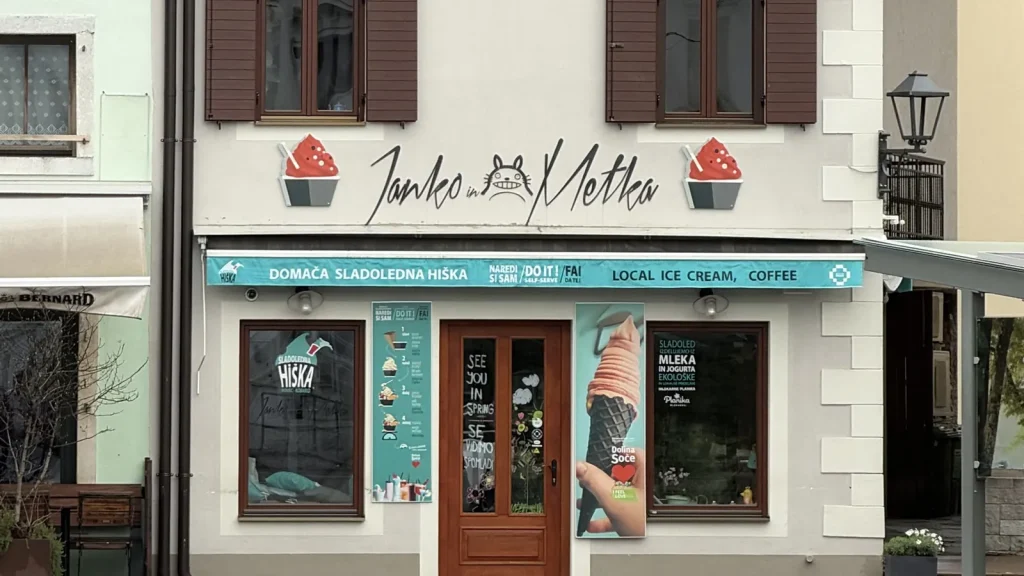
- Janko in Metka: a cute homemade ice cream and coffee shop on the square, with ice cream made from organic milk and yoghurt from the local Planika dairy. It’s seasonal, though. When we visited, a “See you in spring” sign was on the door.
Where to stay in Kobarid
Kobarid works as a day trip, but it’s much nicer to stay a night, eat a long dinner and see the valley in the morning light. Most places are small, family-run and good value. Here are the ones I’d look at first:
- Hotel Hvala: a family-run hotel right in the centre, home of the Topli Val restaurant. The classic choice if you want a proper hotel, breakfast included and dinner downstairs.
- Hiša za Gradom: apartments with a garden, barbecue and free parking. Great for families who want a bit more space and a kitchen.
- Kamp Koren: an eco campsite on the left bank of the Soča, a short walk from town, with wooden chalets and glamping huts as well as pitches. It was the first campsite in Slovenia to get the EU Ecolabel, and it has a playground, sauna and adventure park.
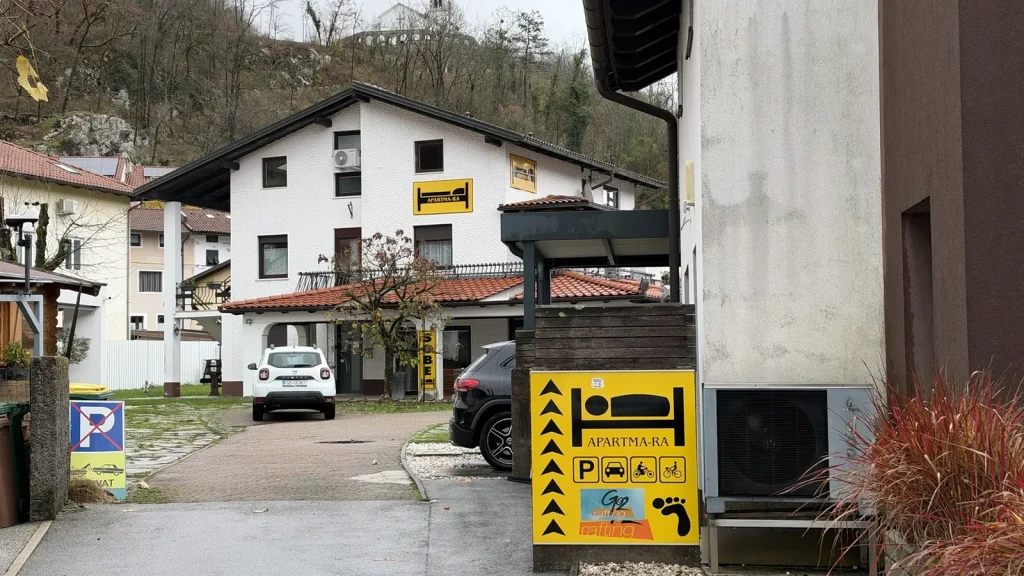
- Apartma-Ra: simple rooms and apartments with parking just off the centre, popular with cyclists and rafters. You can’t miss the big yellow signs.
- Jelenov breg pod Matajurem: a farm stay in the hills under Mount Matajur, if you want quiet, views and home cooking.
For everything else, including more apartments and glamping spots in the valley, browse all places to stay in Kobarid. In July and August, book early: the valley fills up with rafters and hikers.
Kobarid with more time
- Rafting, kayaking or SUP on the Soča. The stretch near Kobarid is gentler than the famous rapids around Bovec, which makes it a good first rafting trip. The season runs from spring to autumn.
- Bovec and the upper Soča. Half an hour up the valley you’ll find more rafting, canyoning and ziplines. See our guide to the best ziplines in Slovenia.
- Vršič Pass and Kranjska Gora. In summer, the mountain road over Vršič connects the Soča valley with Kranjska Gora. It’s closed in winter, when Kranjska Gora turns into a ski town, see our Kranjska Gora ski guide.
- Skiing nearby. If you come in winter like we did, look at Vogel above Lake Bohinj or our full list of the best ski resorts in Slovenia.
- Mount Krn. At 2,244 m, Krn is the big summit above Kobarid and a serious full-day hike, best from July to September.
- Across the border. Cividale del Friuli and the Natisone valley in Italy are close by, so it’s easy to add a second country to the trip.
Best time to visit Kobarid
- May to June: my top pick. Green valley, full rivers, waterfalls at their best and fewer people than summer.
- July and August: warm, lively and perfect for the river, but busy, with higher prices.
- September and October: calm, golden and great for hiking. The Kozjak entrance point stays open until the end of October.
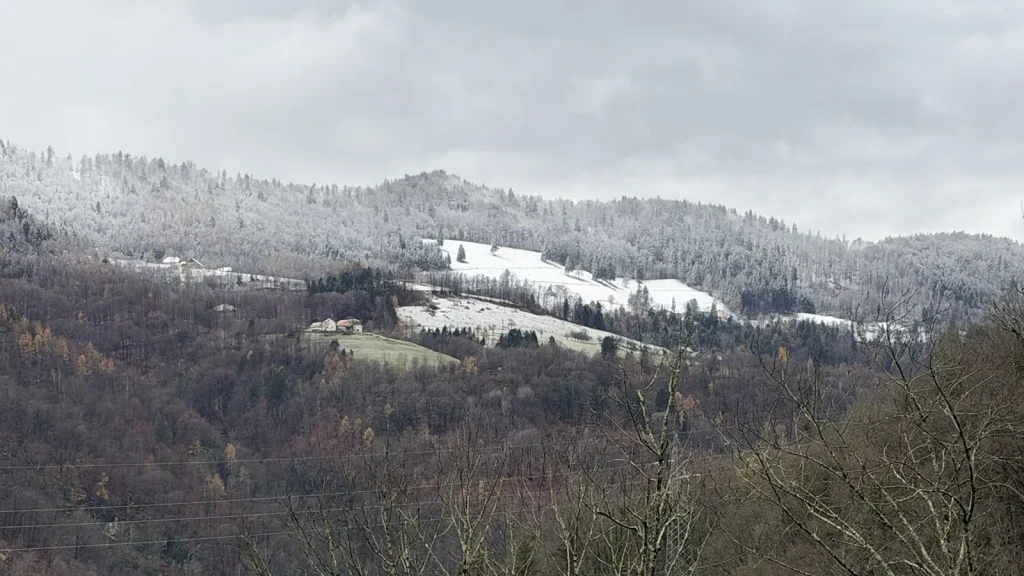
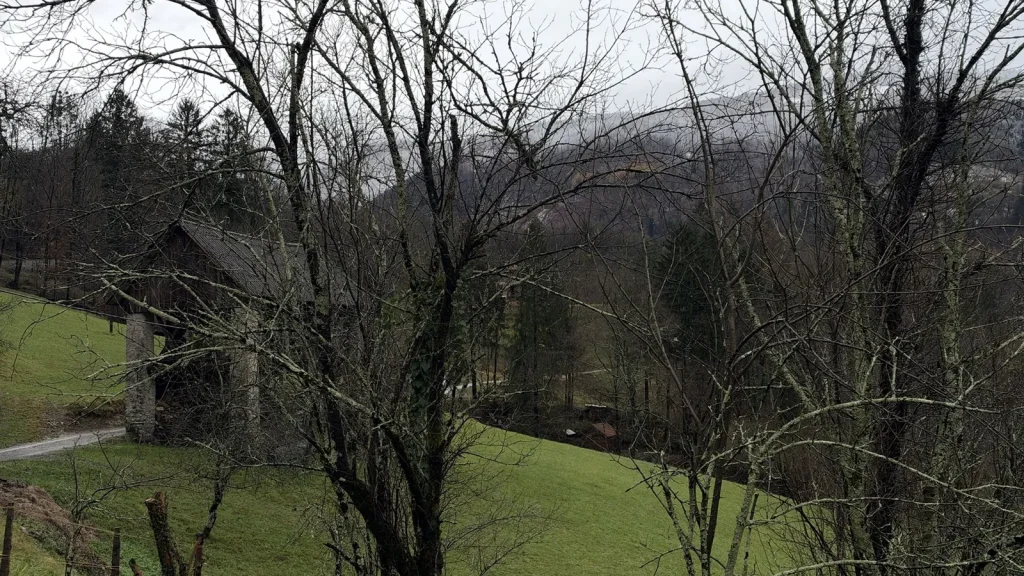
- November to March: quiet and moody. Expect cold, rain or sleet like we had, and some seasonal places will be closed. The museum, the Charnel House and most restaurants are still worth the trip, and you’ll have them almost to yourself.
Practical tips for your Kobarid day trip in 2027
- Tourist information: the TIC Kobarid office is on Trg svobode 16, on the main square. You can find events and practical info on the official Soča Valley website.
- Julian Alps: Soča Valley card: if you’re staying a few nights, it gives free entry to the Kobarid Museum and the Kozjak Waterfall, among other things.
- Pack layers: the weather in the valley changes fast. Bring a rain jacket even in summer, and warm layers and waterproof shoes from November.
- Cash and cards: cards are widely accepted, but carry a little cash for small cafés and parking machines.
- Book dinner: Hiša Franko weeks or months ahead, the others a day or two ahead in summer.
- Languages: Slovenian, but Italian and English are widely spoken. Croatian speakers will get by easily too.
Coming from Croatia? Kobarid pairs nicely with a few days on the coast. Our 10 days in Croatia itinerary starts in Istria, and our guide to Roman temples in Croatia covers Pula’s Temple of Augustus if you’re starting where we did.
Kobarid FAQ
Is one day enough for Kobarid?
Yes, for the town itself. One day covers the museum, the Charnel House, a walk around the centre and a good meal. Add a second day if you want the full historical trail, the Kozjak Waterfall and time on the river.
How far is Kobarid from Pula?
It took us about three hours by car from Pula, with a short stop. Traffic at the border crossings in summer can add more.
What food is Kobarid known for?
Frika (potatoes fried with Tolminc cheese), kobariški štruklji (sweet dumplings with walnuts and raisins), Soča trout and, of course, Hiša Franko’s tasting menu.
Is Kobarid good with a baby or small kids?
Yes. The centre is small and flat, the museum is indoors, and the road up to the Charnel House is paved. For the waterfall trail, bring a baby carrier rather than a stroller.
Can you visit the Kozjak Waterfall in winter?
The entrance point is only staffed from April to October. Outside that season, the trail can be icy and slippery, so only go in good conditions and with proper footwear.
Cold fingers, sleet and a baby in a snowsuit, and I’d still do this day again tomorrow. If you’re in Istria or anywhere in western Slovenia, give Kobarid a day. Start with the museum, end with a view from the hill, and don’t leave without trying the frika.

Miki Kokica
Travel blogger behind One Day Itinerary. I test every route myself and write honest, practical guides so you can make the most of a single day anywhere.
Work with me Instagram










