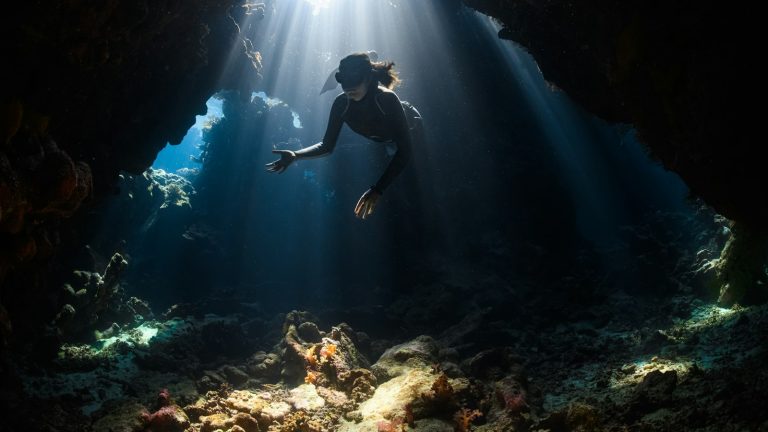
If you’ve only ever thought of Jordan as Petra, Wadi Rum and the Dead Sea, Aqaba is the plot twist. Jordan’s tiny slice of Red Sea coast is only around 26 km long, yet it packs in coral gardens you can reach straight from the beach, a sunken cargo ship that’s covered in soft coral, and a whole “army” of tanks and helicopters lying on the sand. For me, diving in Aqaba is one of the easiest ways to add a completely different side of Jordan to a desert-and-ruins trip, and most dives start with a short walk into the water rather than a long boat ride.
What to expect, honestly: the water is warm (about 20–21°C in February, up to around 28°C in August), visibility is usually good, and the sites are compact and close together along the coast south of town. Jordan isn’t a shark-and-pelagics destination; the stars here are the coral, the wrecks, turtles, morays and huge Napoleon wrasse. It’s great for beginners and new divers, very good for wreck fans, and snorkellers get more than they would in most Red Sea resort towns because so much of the action is shallow.
Aqaba dive sites at a glance
| Spot | Area | Level | Depth | How to get there | Best for |
|---|---|---|---|---|---|
| Cedar Pride | South coast, near the marine reserve | Beginner–advanced | About 10–27 m | Shore or boat | Classic Red Sea wreck |
| Japanese Garden | Aqaba Marine Reserve | All levels, snorkellers | From about 2 m to 20 m+ | Shore | Coral, turtles, snorkelling |
| Underwater Military Museum | Aqaba coast | All levels (deeper parts for experienced) | About 5–28 m | Shore | Tanks, helicopters, photos |
| The Tank and C-130 Hercules | South coast, near Seven Sisters | Beginners, snorkellers | About 6–17 m | Shore | Easy wrecks, first dives |
| Lockheed TriStar | By King Abdullah Reef, north of the port area | Intermediate | About 10–28 m | Shore or boat | Swim-through plane wreck |
| Seven Sisters | South coast | Beginners | To about 16 m | Shore | Coral pinnacles, fish life |
| Rainbow Reef | South coast | All levels | About 5–40 m | Shore or boat | Colourful shallows, turtles |
| Gorgone I | South coast | Beginners | To about 18 m | Shore | Big gorgonian fan, relaxed dive |
| Power Station | About 5 km south of town | Experienced | About 7–40 m | Shore or boat (often a drift) | Wall diving |
Depths are approximate and vary with where your guide plans the dive; most sites can be done shallower for newer divers.
1. Cedar Pride, south coast: Aqaba’s signature wreck
The Cedar Pride is the dive everyone talks about, and for good reason. She’s a 74 m Lebanese cargo ship that caught fire in Aqaba’s port in 1982 and was deliberately sunk as an artificial reef in 1985. She lies on her port side on two reef outcrops, so the starboard side sits at only around 10 m while the deepest parts reach about 27 m.
Four decades underwater have turned her into a proper reef, and the coral-encrusted crow’s nest is one of the most photographed spots in the Gulf of Aqaba. Because the wreck starts shallow, Open Water divers can enjoy a lot of it.
- How to get there: Usually done as a shore dive (a short surface swim from the beach) or from a boat; dive centres along the south coast run it daily.
- Level/depth: Beginner to advanced, about 10–27 m.
- What you’ll see: Napoleon wrasse, lionfish, angelfish, big snappers, barracuda, soft corals and sea fans.
- Tip: If you’re newly certified, ask for a plan that stays on the shallow starboard side and the crow’s nest rather than chasing the deepest point.
2. Japanese Garden, Aqaba Marine Reserve: the best reef for snorkellers too
If Aqaba had a “greatest hits” reef, this would be it. The Japanese Garden sits inside the protected marine reserve that runs along Jordan’s southern coast, and the coral starts just a couple of metres below the surface, which makes it as good for snorkellers as it is for divers. Pinnacles and coral heads slope away into deeper water, so a dive can be a gentle shallow potter or something more ambitious.
- How to get there: Shore entry from the beach on the south coast, a short walk into the water.
- Level/depth: All levels; coral from about 2 m, deeper sections around 20 m and beyond.
- What you’ll see: Turtles, seahorses (if you’re lucky), moray eels, nudibranchs, triggerfish, groupers and lionfish.
- Tip: This is the site I’d pick for a first dive or try-dive. Go early, before the busiest snorkel groups arrive.
3. Underwater Military Museum: tanks and helicopters on the sand
This is the site that makes non-divers stop scrolling. In 2019 the Aqaba Special Economic Zone Authority placed around 20 decommissioned military machines on the seabed, arranged in “tactical formation” across roughly 140 m of sand. You’ll find Cobra attack helicopters standing upright, tanks, armoured personnel carriers, anti-aircraft units, field guns, an ambulance and jeeps.
The layout is clever: the jeeps sit at around 5 m close to the beach, while the helicopters are deeper at about 25–28 m. That means snorkellers can see the shallow pieces, Open Water divers can explore a good chunk while watching their depth, and experienced divers can do the whole lot. Most people need two dives to see everything properly.
- How to get there: Shore dive, only a few dozen metres from the beach; most Aqaba dive centres include it.
- Level/depth: All levels for the shallow part; about 25–28 m for the helicopters.
- What you’ll see: Military hardware slowly turning into reef, plus turtles, frogfish, anthias, bannerfish and pufferfish.
- Tip: It’s a fantastic photo site. Ask your guide to time the dive so you aren’t sharing the helicopters with a big group.
4. The Tank and the C-130 Hercules: the easiest wrecks in the Red Sea
Before the military museum existed, there was the Tank: an M42 “Duster” anti-aircraft vehicle sunk in 1999 by the Jordanian Royal Ecological Diving Society as Aqaba’s first artificial reef. It sits on a sandbank at only about 6 m, around 20 m from shore, which is why so many people do their first ever wreck dive here.
Close by lies a Lockheed C-130 Hercules transport plane, sunk in 2017 in under 18 m of water. A later storm broke it up, but it’s still a fun, easy plane dive with schools of fish and the odd moray eel. Together they make a perfect beginner double, and the Tank is shallow enough to snorkel.
- How to get there: Shore entry on the south coast, near Seven Sisters.
- Level/depth: Beginner; about 6 m for the Tank, up to about 17 m for the Hercules.
- What you’ll see: Starfish, crabs, shrimp, small corals and reef fish living on the metal.
- Tip: This is a great site for a Discover Scuba Diving session or for practising buoyancy on your course.
5. Lockheed TriStar, King Abdullah Reef: a whole passenger jet
The TriStar is the newest big wreck here, scuttled by ASEZA around 2020 next to the King Abdullah Reef dive site, by the Aqaba Container Terminal. It’s a huge Lockheed L-1011 airliner, around 54 m long, lying on a sandy slope with the cockpit at about 10 m and the tail around 26–28 m.
The doors and the middle row of seats were removed before sinking so divers can swim through the cabin, and seeing the rows of seats underwater is surreal.
- How to get there: North of the main south-coast sites; dive centres reach it by boat or car plus a shore entry.
- Level/depth: Intermediate; about 10–28 m.
- What you’ll see: The cockpit windows, the cabin and growing fish life around the fuselage.
- Tip: Bring a torch for the inside, and only go into the cabin with a guide if you’re comfortable with overhead environments.
6. Seven Sisters, south coast: coral pinnacles for new divers
Seven Sisters is named after its seven coral-covered pinnacles, and it’s one of the most relaxed dives on the coast. The maximum depth is around 16 m, there’s lots to look at in a small area, and it’s commonly used for training dives.
- How to get there: Shore entry on the south coast.
- Level/depth: Beginner; to about 16 m.
- What you’ll see: Hard and soft corals, fan worms, shoals of small fish, octopus and turtles.
- Tip: Slow down and look into the cracks; this is a good site to spot octopus.
7. Rainbow Reef, south coast: colour in the shallows
Rainbow Reef earns its name in the shallows, where the corals are at their most colourful. The reef drops from around 5 m down to about 40 m, so it suits everyone from snorkellers to experienced divers, and turtles are often seen here.
- How to get there: Shore or boat, on the south coast.
- Level/depth: All levels; about 5–40 m.
- What you’ll see: Colourful coral, reef fish and turtles.
- Tip: The best colours are in the top 10 m, so a long, shallow dive here is often better than going deep.
8. Gorgone I, south coast: the giant fan
Gorgone I is named after a big gorgonian fan at around 16 m, and you reach the reef via a zigzag path through the fringing reef from shore. There are three pinnacles to explore and the maximum depth is about 18 m, which makes it another easy, relaxed dive.
- How to get there: Shore entry through the channel in the fringing reef.
- Level/depth: Beginner; to about 18 m.
- What you’ll see: Arabian angelfish, yellow-mouth morays and cabbage coral.
- Tip: Follow your guide closely on the entry path so you don’t kick the shallow reef.
9. Power Station, south of town: a wall for experienced divers
About 5 km south of Aqaba, the Power Station site is a wall that’s often done as a drift dive. Depths range from about 7 m to 40 m, so it’s one for divers with some experience and good air consumption, not for a first day in the water.
- How to get there: Shore or boat, depending on the dive centre and current.
- Level/depth: Experienced; about 7–40 m.
- What you’ll see: Wall corals, moray eels and, occasionally, reef sharks (one of the few Aqaba sites where they’re reported).
- Tip: Technical divers can also ask about the Taiyong, a crane barge lying at about 35–57 m, which is well beyond recreational limits.
Best time for diving in Aqaba in 2027
You can dive Aqaba all year. The sweet spots are April–June and September–November, when the water is warm, the air is bearable and conditions are usually good. Sea temperatures run roughly like this: about 20–21°C from January to March, 22–24°C in April and May, 25–28°C from June to October (warmest in August at around 28°C) and back to about 23–25°C in November and December.
Summer (June to September) brings the warmest water and often calm seas, but air temperatures regularly hit 38–40°C, so you’ll want early dives and lots of shade. Winter is quieter and pleasant on land, but stronger winds can stir up the water and you’ll want a thicker wetsuit. Plankton blooms in spring can lower visibility for a while; on a good day it can reach 30–40 m.
Courses, prices and how to book
- Fun dives: Most centres price guided shore dives per dive, with a discount if you bring your own gear and a supplement for boat days. Ask for the full price list (equipment, guide, transport) before you book.
- Snorkelling: You can snorkel from the beach clubs on the south coast with your own or rented gear, or join a half-day boat snorkelling trip, which often includes lunch.
- Courses: Local centres run PADI and SSI Open Water courses over a few days; booking directly with a centre is usually cheaper than a package with transfers bought through a travel site.
- Try-dive: Discover Scuba Diving sessions are offered by most centres for non-certified beginners, usually on a shallow shore site like the Tank or Japanese Garden.
- Fees: Ask whether marine park and site fees are included; many dive packages include them.
- How to book: Most dive centres are clustered along the south coast road and many offer hotel pick-ups. Look for a PADI or SSI centre with small groups, well-maintained gear and clear dive briefings. Aqaba’s King Hussein International Airport is close to town, and many visitors come down from Petra or Wadi Rum by road.
What to pack
- Certification card and logbook (or app), plus your dive insurance details
- Your own mask, and a 5 mm wetsuit in winter and spring (3 mm or a shorty is fine in summer)
- Reef-safe sunscreen, a sun hat and a long-sleeved rash guard for snorkelling
- Water shoes or booties for the beach entries
- A torch if you plan to dive the TriStar or do a night dive
- A light cover-up for walking around town
Safety tips
- Don’t fly within 18–24 hours after diving, and plan the drive up to Petra or Amman with that in mind if you’re flying home from there.
- Check that your travel insurance covers scuba diving, including the depth you plan to dive.
- If you’re not certified, do a supervised Discover Scuba Diving session with a registered centre rather than diving on your own.
- Stay within your certification limits; the helicopters at the military museum and the TriStar’s tail are deeper than they look from shore.
- Never touch the coral or wrecks, and watch out for fire coral and lionfish spines.
- Snorkellers should stay inside marked swimming areas and away from boat channels, especially near the port.
- Check your government’s current travel advice for Jordan before you go.
Aqaba diving FAQ
Is Aqaba good for beginner divers?
Yes, it’s one of the best places in the Red Sea for beginners. Most sites are shore dives with easy entries, many start in just a few metres of water, and wrecks like the Tank sit at around 6 m.
Can you snorkel the Cedar Pride and the military museum?
The Cedar Pride’s shallowest side is about 10 m down, so snorkellers only see the outline in good visibility. The military museum is better: the jeeps and other pieces in the shallows sit at around 5 m and are easy to see from the surface.
What is the water temperature in Aqaba?
It ranges from about 20–21°C in February and March to around 28°C in August. A 5 mm wetsuit is comfortable in winter; in summer a 3 mm or shorty is enough for most people.
Do I need a boat to dive in Aqaba?
No. Most of Aqaba’s best sites, including the Japanese Garden, the Tank, Seven Sisters and the military museum, are done from shore. Boats are used for some sites and for snorkelling trips.
Will I see sharks in Aqaba?
Probably not. Jordan’s coast isn’t known for sharks or big pelagic fish. Turtles, moray eels, Napoleon wrasse and lots of reef fish are much more typical.

Written by
Miki Kokica
Travel blogger behind One Day Itinerary. I test every route myself and share honest, practical guides so you can plan better trips in less time.
Work with me Instagram