Thailand has more than 40,000 Buddhist temples, and after a while even the golden ones can start to blur together. That’s why I wrote this guide to the best temples in Thailand: it’s the shortlist I’d give a friend, from the glittering royal temples of Bangkok to mountain-top Doi Suthep in Chiang Mai, the surreal White Temple in Chiang Rai, the ruined capital of Ayutthaya and the 1,260-step Tiger Cave Temple in Krabi. For each one you’ll find what makes it special, current ticket prices, how to get there and my honest tips on timing.
This is the hub of my Thai temple series, so wherever a temple has its own detailed guide, I link to it. Prices are in Thai baht (THB). Thai temples change fees more often than you’d think (the White Temple doubled its price recently), so treat the numbers as a guide for 2027 and check on the day.
Best temples in Thailand at a glance
| Temple | Where | Entry (foreigners) | Time needed | Best for |
|---|---|---|---|---|
| Wat Phra Kaew and Grand Palace | Bangkok | 500 THB | 2–3 hours | Royal architecture, Emerald Buddha |
| Wat Pho | Bangkok | 300 THB | 1–2 hours | Reclining Buddha, Thai massage |
| Wat Arun | Bangkok | 200 THB | 1 hour | Riverside views, porcelain prang |
| Wat Saket (Golden Mount) | Bangkok | 100 THB | 1 hour | Sunset over the old town |
| Wat Phra That Doi Suthep | Chiang Mai | 30 THB | Half day | Mountain temple, city views |
| Wat Chedi Luang | Chiang Mai | Around 50 THB | 45 minutes | Huge ruined chedi, monk chat |
| Wat Rong Khun (White Temple) | Chiang Rai | 200 THB | 1–1.5 hours | Modern art temple |
| Wat Rong Suea Ten (Blue Temple) | Chiang Rai | Free | 30–45 minutes | Photos, intense colour |
| Ayutthaya Historical Park | Ayutthaya | 80 THB per site or 300 THB combined | Full day | Ancient ruins, Buddha head in tree |
| Tiger Cave Temple (Wat Tham Suea) | Krabi | Free | 2–3 hours | 1,260-step climb, sunrise views |
| Big Buddha and Wat Chalong | Phuket | Free | 2 hours for both | Island views, easy half day |
1. Wat Phra Kaew and the Grand Palace, Bangkok: Thailand’s most sacred temple
If you visit only one temple in Thailand, make it this one. Wat Phra Kaew sits inside the walls of the Grand Palace and houses the Emerald Buddha, a small image of green jade or jasper only about 66 cm tall that is the country’s most revered Buddha image. Its gold costume is changed with the seasons in a royal ceremony, three times a year. Around it you’ll find a golden chedi, gilded guardian demons, a model of Angkor Wat and long galleries of Ramakien murals.
The palace part is just as impressive, especially the Chakri Maha Prasat throne hall, which mixes a European-style body with Thai roofs. It’s crowded, hot and expensive by Thai standards, but it’s genuinely spectacular. My full Grand Palace and Wat Phra Kaew guide covers the dress code and the scams in detail.
- Tickets: 500 THB for foreigners, including the Queen Sirikit Museum of Textiles. Thai nationals enter free.
- Hours: Daily from 8:30, with ticket sales ending at 15:30. It occasionally closes for royal ceremonies.
- How to get there: Chao Phraya boats to Tha Chang pier (N9), or MRT to Sanam Chai and a short walk.
- Tip: Be at the gate at 8:30, before the tour groups. Ignore anyone outside who tells you the palace is “closed today”.
2. Wat Pho, Bangkok: the Reclining Buddha and the home of Thai massage
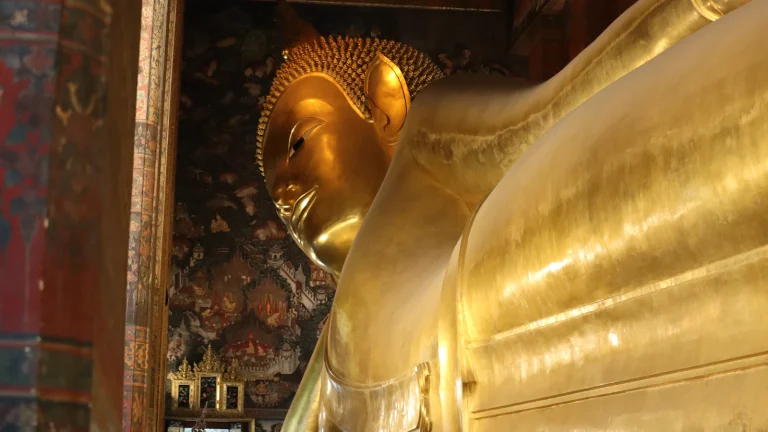
Wat Pho is a five-minute walk south of the Grand Palace, and I actually like it more. The famous Reclining Buddha is 46 m long and 15 m high, covered in gold leaf, with mother-of-pearl soles showing 108 auspicious symbols. But the rest of the complex is the real joy: quiet courtyards, four tall chedis covered in ceramic tiles, and hundreds of Buddha images lining the cloisters.
Wat Pho is also the traditional centre of Thai massage. The temple’s massage school offers treatments on site, with a 30-minute Thai or foot massage at 340 THB and an hour at 520 THB.
- Tickets: 300 THB. Children under 120 cm enter free.
- Hours: Daily 8:00–19:30, according to the temple’s own website.
- How to get there: Tha Tien pier (N8) is right behind the temple.
- Tip: Swap a 20 THB note for small coins and drop one into each of the 108 bronze bowls along the Reclining Buddha hall for good luck.
3. Wat Arun, Bangkok: the Temple of Dawn on the river
Wat Arun stands on the Thonburi bank of the Chao Phraya, right opposite Wat Pho. Its central prang (a Khmer-style tower) is covered in colourful pieces of porcelain, many of them from ballast carried by ships from China. Up close the detail is wonderful, and you can climb part of the way up the very steep steps for views across the river.
- Tickets: 200 THB for foreigners, usually with a small bottle of water.
- Hours: About 8:00–18:00, last entry around 17:30.
- How to get there: The cross-river ferry from Tha Tien, behind Wat Pho, takes a few minutes and costs about 5 THB.
- Tip: Visit in the afternoon, then cross back to the Tha Tien side and watch the sunset behind the prang from a riverside terrace.
4. Wat Saket (Golden Mount), Bangkok: the best sunset temple
Wat Saket is my favourite Bangkok temple for the end of the day. A spiral staircase of a few hundred steps winds up an artificial hill, past bells and small waterfalls, to a golden chedi with 360-degree views over the old town. The hill itself has a funny history: King Rama III tried to build a giant chedi here, it collapsed in Bangkok’s soft soil, and the ruin slowly became a grassy mound.
- Tickets: 100 THB.
- Hours: Roughly 7:30–19:00.
- Tip: Go around 17:00. In November the temple holds its big annual fair with a candlelit procession up the hill.
For more temples in the capital, including the Golden Buddha at Wat Traimit and the Marble Temple, plus a one-day route, see my guide to the best temples in Bangkok.
5. Wat Phra That Doi Suthep, Chiang Mai: the temple on the mountain
Doi Suthep is the temple that defines Chiang Mai. It sits at around 1,000 m on the mountain of the same name, about 15 km from the old city. A staircase of about 306 steps, flanked by long naga serpents, leads to a gleaming golden chedi, and on a clear day the terrace looks out over the whole city. If you’re fit, you can hike up the forested Monk’s Trail via the little jungle temple of Wat Pha Lat.
- Tickets: 30 THB for foreigners. A small funicular is an alternative to the stairs.
- How to get there: Shared red songthaews leave from in front of Chiang Mai University, about 50 THB per person one way once the truck is full. Grab and private drivers are easy too.
- Tip: Go early in the morning for clear views and chanting monks. The national park now charges foreigners a separate 100 THB fee on the Pha Lat nature trail.
6. Wat Chedi Luang, Chiang Mai: the giant broken chedi
In the middle of Chiang Mai’s old city stands a huge brick chedi that was once the tallest structure in the Lanna kingdom, until an earthquake in 1545 brought down its top. It once housed the Emerald Buddha that’s now in Bangkok, and a replica now sits in its eastern niche. It’s also one of the best places in Chiang Mai for a “monk chat”, where young monks practise their English with visitors.
- Tickets: Around 50 THB, cash.
- Tip: Combine it with nearby Wat Phra Singh and Wat Chiang Man on a walk. My guide to the best temples in Chiang Mai has a route and the silver temple too.
7. Wat Rong Khun (White Temple), Chiang Rai: a temple like nowhere else
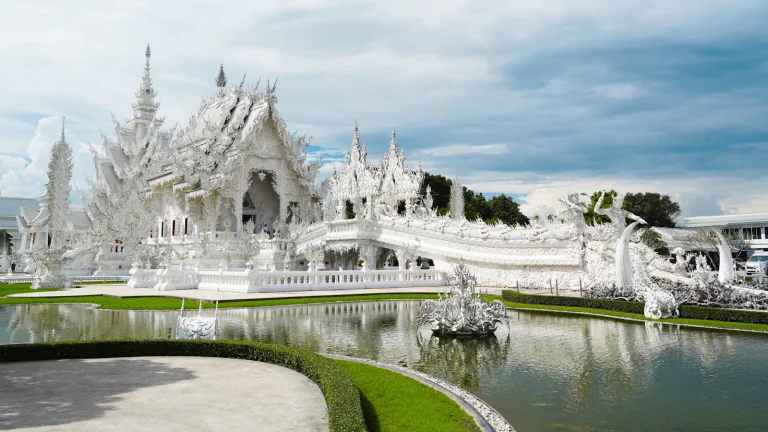
The White Temple is not an ancient monument at all. It was designed by Thai artist Chalermchai Kositpipat and opened in 1997, and it’s still being expanded. Everything is white and inlaid with mirrors, and to reach the main hall you cross a bridge over hundreds of sculpted hands reaching up from “hell”. Inside, the murals mix Buddhist imagery with superheroes and pop culture. You’ll either love it or find it slightly mad, and I think that’s the point.
- Tickets: 200 THB for foreigners, including the Cave of Art. Visitors aged 70+ and children under 120 cm enter free.
- How to get there: About 13 km south of Chiang Rai town. Most people come on a long day tour from Chiang Mai, but staying a night in Chiang Rai is much more relaxed.
- Tip: Arrive at opening time. By late morning it’s packed with tour buses.
I cover the White Temple, the Blue Temple and the Black House together in my Chiang Rai temples day trip guide.
8. Wat Rong Suea Ten (Blue Temple), Chiang Rai: the electric-blue one
Just north of Chiang Rai town, the Blue Temple is covered in deep sapphire blue with gold details, and inside a white Buddha glows against blue walls. It’s newer and smaller than the White Temple, free to enter, and a great second stop. Nearby, the Black House (Baan Dam) is not a temple but an artist’s museum of dark teak buildings, bones and horns, and it costs about 80 THB. It’s an interesting contrast to the temples if you have the time.
9. Ayutthaya: the ruined royal capital
Ayutthaya was the capital of Siam for over four centuries until it was sacked in 1767, and today its ruins are a UNESCO World Heritage Site about 80 km north of Bangkok. The highlights are the Buddha head wrapped in tree roots at Wat Mahathat, the three tall chedis of Wat Phra Si Sanphet and the riverside prangs of Wat Chaiwatthanaram, which glow at sunset.
- Tickets: 80 THB per site, or a 300 THB combined ticket covering seven sites, including Wat Mahathat, Wat Phra Si Sanphet and Wat Chaiwatthanaram.
- How to get there: Trains from Bangkok take about 1.5–2 hours and cost very little. Rent a bicycle or hire a tuk-tuk for the day once you arrive.
- Tip: When you photograph the Buddha head at Wat Mahathat, crouch down so your head is never higher than the Buddha’s. Guards will remind you.
My Ayutthaya temples day trip guide has a full route by bike, boat and tuk-tuk.
10. Tiger Cave Temple (Wat Tham Suea), Krabi: 1,260 steps to the sky
If you’re in Krabi for the beaches, give one morning to this. Wat Tham Suea is a working forest monastery about 9 km from Krabi Town, and its most famous feature is a staircase of 1,260 very steep steps up a limestone tower to a golden Buddha and a small chedi. The view over the karst peaks, rice fields and Andaman coast is one of the best in southern Thailand.
- Tickets: Free.
- Hours: About 6:00–18:00.
- Time: Most people need 35–60 minutes up. Take plenty of water.
- Tip: Start before 9:00 to avoid the worst heat, and keep food and sunglasses out of sight, because the macaques are bold. See my Tiger Cave Temple guide for the climb in detail.
11. Big Buddha and Wat Chalong, Phuket: the island’s two essentials
Phuket’s Big Buddha is a 45 m seated Buddha covered in white Burmese marble on a hilltop between Kata and Chalong. The views over the bays are the main reason to come, and it’s free. About ten minutes away, Wat Chalong is Phuket’s most important temple, with a tall pagoda you can climb, said to hold a relic of the Buddha.
- Big Buddha hours: 9:00–18:00, last entry 17:30. Free sarongs at the entrance.
- How to get there: Drive or take a Grab up the signposted road from Chalong Circle, about 20 minutes from Kata and Karon.
- Tip: Go in the late afternoon when the light softens. My Phuket temples guide adds the smaller temples and shrines of Old Town.
If you have more time
Temple lovers on a longer trip should consider Sukhothai, the older capital between Bangkok and Chiang Mai, where you can cycle between lotus ponds and seated Buddhas, and Wat Phra That Lampang Luang, a beautiful old Lanna temple near Lampang. In Chiang Mai, Wat Umong’s forest tunnels and the silver Wat Sri Suphan are both worth an evening.
Best time to visit Thailand’s temples in 2027
For Bangkok and the north, I’d go between November and February. It’s the cool, dry season, and walking around temple complexes at midday is actually bearable. March to May is very hot, and in the north the burning season often brings heavy smoke and poor air quality from roughly February to April. The rainy season runs roughly June to October, which means greener landscapes and fewer visitors but daily downpours.
For Krabi and Phuket, the drier months are roughly November to April. Whatever the season, the rule is the same everywhere: start at opening time. Temples are cooler, quieter and more atmospheric in the first hours of the day.
- Loy Krathong and Yi Peng: Usually in November, when candles and lanterns light up temples, especially in Chiang Mai. Beautiful, but book accommodation early.
- Songkran: Thai New Year, 13–15 April, is famous for water fights, but also for ceremonies at temples.
- Buddhist holidays: On major holy days, temples are busy with worshippers and alcohol sales are restricted.
Thai temple dress code and etiquette
Thai temples are active places of worship, and the big ones enforce their dress code strictly. This is what I always keep in mind:
- Cover shoulders and knees. No tank tops, crop tops, short shorts or mini skirts. Avoid see-through and very tight clothing too.
- Bring a scarf or sarong. Many temples rent or lend them, but having your own saves time.
- Shoes off before entering any hall with a Buddha image. Slip-on shoes make life easier.
- Feet down. Never point your feet at a Buddha image or a monk. When you sit, tuck them behind you.
- Women and monks: Women shouldn’t touch monks or hand things directly to them. Some halls, such as the silver ubosot at Wat Sri Suphan, are closed to women.
- Respect the images. Don’t climb on statues or pose in silly ways with them, and keep your voice down inside.
- Photos: Some halls, including the Emerald Buddha’s, don’t allow photography inside. Drones are banned over the Grand Palace.
How much do Thai temples cost?
Most small temples are free, and a donation of 20–100 THB is appreciated. The famous temples charge foreigners only, while Thai nationals usually enter free. In 2027, a full day of Bangkok’s big three (Grand Palace, Wat Pho and Wat Arun) costs 1,000 THB in tickets. Northern temples are much cheaper, usually 20–50 THB, with the White Temple as the exception at 200 THB. Carry cash, because card and QR payment isn’t always available at ticket counters.
Where to stay for temple hopping in Thailand
For temples, location matters more than anywhere else. In Bangkok stay in the old town (Rattanakosin) near the river so you can walk to the big three at opening time. In Chiang Mai, the old city puts dozens of temples on your doorstep. These are properties I’d look at first:
| Base | Hotel | Category | Why |
|---|---|---|---|
| Bangkok, Tha Tien | Sala Rattanakosin | Luxury | Riverside rooms facing Wat Arun, steps from Wat Pho |
| Bangkok, Phra Athit | Riva Surya Bangkok | Mid-range | On the river near Khao San, next to Phra Athit boat pier |
| Chiang Mai, old city | Tamarind Village | Luxury | Lanna-style oasis a short walk from Wat Chedi Luang |
| Chiang Rai | Le Méridien Chiang Rai Resort | Luxury | Riverside resort, easy base for the White and Blue Temples |
| Ayutthaya | Sala Ayutthaya | Mid-range to luxury | River views of an old temple, ideal for sunset at the ruins |
| Krabi, Ao Nang | Centara Ao Nang Beach Resort and Spa | Mid-range | Beach base with an easy drive to the Tiger Cave Temple |
Planning the rest of the trip? My Thailand travel guide covers routes, transport and the islands.
Best temples in Thailand FAQ
What is the most famous temple in Thailand?
Wat Phra Kaew, the Temple of the Emerald Buddha inside Bangkok’s Grand Palace, is the most sacred and famous. Wat Pho, Wat Arun and the White Temple in Chiang Rai are close behind.
How many temples should I visit in one day?
Three or four is plenty. In Bangkok, the Grand Palace, Wat Pho and Wat Arun fit nicely into one day because they’re all within walking distance or a short ferry ride of each other.
Are Thai temples free?
Most local temples are free. The big tourist temples charge foreigners, from about 30 THB at Doi Suthep to 500 THB at the Grand Palace. The Tiger Cave Temple, the Blue Temple and Phuket’s Big Buddha are free.
Can I wear shorts to temples in Thailand?
Not to the major temples. Knees and shoulders must be covered, for men and women. Long, loose trousers or a long skirt and a T-shirt are the safest choice.
Is Chiang Mai or Bangkok better for temples?
Bangkok has the grandest royal temples, while Chiang Mai has more of them, with a calmer atmosphere and cheaper tickets. Ideally, see both. If you have to choose, Bangkok for the wow factor, Chiang Mai for the mood.
Can I visit the White Temple as a day trip from Chiang Mai?
Yes, many tours do it in a long day, with about three hours’ drive each way. I’d rather stay a night in Chiang Rai and arrive at opening time.
When is the best time to visit Thai temples?
November to February for Bangkok and the north, and as early in the morning as possible on any day of the year.

Written by
Miki Kokica
Travel blogger behind One Day Itinerary. I test every route myself and share honest, practical guides so you can plan better trips in less time.
Work with me Instagram