If you only visit one temple in northern Thailand, I’d make it this one. Wat Phra That Doi Suthep sits on a forested mountain above Chiang Mai, with a golden chedi that glows in the late afternoon sun and a view over the whole city when the air is clear. Getting there is half the fun: you can ride a shared red songthaew up the winding road, take the little funicular instead of the stairs, or earn the view by hiking the Monk’s Trail through the jungle past the hidden temple of Wat Pha Lat.
This guide covers everything you need for 2027: how to get up the mountain, what the 306-step naga staircase is really like, ticket prices, the dress code, the Monk’s Trail hike step by step, and how to combine Doi Suthep with Bhubing Palace and the Hmong village of Doi Pui.
Doi Suthep at a glance
| What | Details |
|---|---|
| Full name | Wat Phra That Doi Suthep (Doi Suthep Temple) |
| Location | Doi Suthep-Pui National Park, about 15 km west of the Old City |
| Temple altitude | Roughly 1,070 m (the mountain summit is 1,676 m) |
| Temple fee | 30 baht for foreigners |
| Funicular | Small extra fee (around 20–50 baht), or climb 306 steps for free |
| Opening hours | Daily from early morning to early evening (plan for about 6 am–6 pm) |
| Dress code | Shoulders and knees covered, shoes off on the upper terrace |
| Time needed | 1.5–2 hours at the temple, half a day with transport, a full morning if you hike |
| Best time | November–February, early morning or the hour before sunset |
Why Doi Suthep is Chiang Mai’s most important temple
Doi Suthep is the temple locals point to when they talk about Chiang Mai. According to legend, a relic believed to be a piece of the Buddha’s shoulder bone was placed on the back of a white elephant in the 14th century. The elephant climbed the mountain, trumpeted three times, circled and knelt down, and the king took this as a sign to build the temple on that spot. The first chedi was completed in 1383, and the temple has been rebuilt and expanded many times since.
What you see today is a compact but dazzling complex: the gilded chedi in the centre of a marble-paved cloister, rows of bells, Buddha images in every style, and a terrace with views over Chiang Mai. It’s an active, working temple, so you’ll see monks, pilgrims walking around the chedi with lotus flowers, and families making merit. That’s exactly what makes it feel special rather than like a museum.
1. The naga staircase: 306 steps to the top
From the parking area and souvenir street, a staircase flanked by two long serpent (naga) balustrades leads up to the temple. The official count is usually given as 306 steps, though you’ll see 309 in some places. It looks intimidating from the bottom, but it’s shaded in parts and most people do it in 10–15 minutes with a few photo stops.
- Difficulty: Easy to moderate. Take it slowly in the heat.
- Alternative: A small funicular (often called the cable car or lift) runs next to the stairs for a small fee. It’s a good option for kids, older travellers or anyone who hiked up the Monk’s Trail.
- Ticket office: You pay the 30 baht foreigner fee at the top before entering the upper terrace.
- Tip: I’d climb up and take the funicular down, or the other way round if your knees prefer it.
2. How to get to Doi Suthep from Chiang Mai
The temple is on Huay Kaew Road (route 1004), which starts near Chiang Mai University and the zoo and winds up the mountain. The drive takes about 30–40 minutes from the Old City.
Red songthaew (the classic way)
Shared red songthaews (pickup trucks with two benches) wait near the front of Chiang Mai University and along Huay Kaew Road near the zoo. They leave when they have enough passengers, usually 6–10. Fares depend on how many people are in the truck: with a full truck, expect around 50 baht one way or about 100 baht return. With only a few passengers, the driver will ask for more. You can also hire a whole songthaew from the Old City for a few hundred baht, and many drivers will add Doi Pui village or Bhubing Palace if you agree in advance.
Grab, Bolt or taxi
Ride-hailing apps work well. A motorbike ride is cheaper, a car costs more, and prices change with demand. Coming down, there are always songthaews waiting at the bottom of the stairs, so you don’t need a return booking.
Scooter or bicycle
The road is paved and in good condition, but it’s steep with tight bends and busy at weekends. I’d only ride up if you’re a confident rider. Strong cyclists love this climb at dawn.
3. The Monk’s Trail hike via Wat Pha Lat
The Monk’s Trail is the path monks once used to walk between the city and the mountain, and it’s my favourite way to reach Doi Suthep. It has two very different parts.
| Section | Distance | Time | Difficulty |
|---|---|---|---|
| Trailhead (end of Suthep Road) to Wat Pha Lat | About 2 km | 40–50 min | Easy to moderate, shaded |
| Wat Pha Lat to Doi Suthep temple | About 5 km | 75–90 min | Steep and harder, slippery when wet |
| Full hike | About 7–7.5 km | 3–3.5 hours with breaks | Around 600 m of elevation gain |
Part one is a well-trodden forest path with orange monk’s robes tied around tree trunks. It ends at Wat Pha Lat, a small, peaceful temple built around a waterfall, with moss-covered naga, stone Buddhas and a viewpoint over Chiang Mai. Many people stop here and walk back down, which is a perfect 2-hour outing.
Part two starts across the main road above Wat Pha Lat and climbs steeply through the forest to Doi Suthep. It’s rougher, with roots and loose ground, and noticeably harder in the rainy season. You come out near the main road just below the temple stairs.
- Getting to the trailhead: A Grab or Bolt from the Old City is typically around 100–150 baht. Ask for the end of Suthep Road near the university.
- Fees: Since late 2025 the national park charges an entry fee at the nature trail (published at 100 baht for foreign adults). Bring cash, and check the current rate.
- Start time: I’d start between 6 and 7 am. You’ll beat the heat and the crowds, and reach Doi Suthep before the tour buses.
- Navigation: The trail is easy to follow if you stay on the main path. A guide isn’t necessary, but download an offline map.
- Going down: Take a songthaew back from the temple, or walk back down the same way.
4. Bhubing Palace and Doi Pui village
If you have a private songthaew or your own wheels, continue up the road. About 20 minutes beyond the temple is Bhubing Palace, the royal family’s winter residence. You can only visit the gardens, which are full of roses and flowers in the cool season. Entry has been around 50 baht for foreigners, with opening hours of about 8:30 am–4:30 pm. The palace usually closes to visitors for part of the cool season (roughly January to March) when the royal family is in residence, and the dates change each year, so check before you go. The dress code is stricter than at the temple: long trousers or a long skirt and covered shoulders.
Further on is Doi Pui, a Hmong village with a market street selling textiles, coffee and dried fruit, plus a small flower garden. It’s touristy but a pleasant stop, and the air is noticeably cooler up here.
Doi Suthep tickets and costs in 2027
| Item | Approximate price |
|---|---|
| Doi Suthep temple (foreigners) | 30 baht |
| Funicular | Around 20–50 baht |
| Shared songthaew from Chiang Mai University | About 50 baht one way, 100 baht return (full truck) |
| Monk’s Trail national park fee | Around 100 baht for foreign adults |
| Bhubing Palace gardens | Around 50 baht for foreign adults |
| Sarong rental at the temple | A few baht, or free |
Prices in Thailand’s national parks and temples have been changing, so treat these as a guide and check the official site of Doi Suthep-Pui National Park or ask at your hotel before you go.
Dress code and etiquette
- Cover your shoulders and knees. No crop tops, very short shorts or see-through clothing.
- Men may also be asked to cover their legs, so long trousers are the safest choice.
- Shoes come off before the upper terrace. Leave them on the racks or carry them in a bag.
- Walk around the chedi clockwise, and never point your feet at a Buddha image.
- Women should not touch monks or hand things directly to them.
- Sarongs are available at the entrance if you arrive in shorts.
Best time to visit Doi Suthep in 2027
The cool season, from November to February, is the best time. Days are dry and fresh, the city views are clearest, and the hike is comfortable. March and April are hot and often hazy because of agricultural burning in northern Thailand, so the view can disappear completely. From June to October it’s green and beautiful, but the Monk’s Trail is muddy and slippery.
As for time of day, I’d go either early (before 9 am) or in the last hour or two before closing. Midday brings the biggest crowds and the hottest marble on bare feet. If you’re in Chiang Mai during Visakha Bucha, thousands of locals walk up the mountain at night, which is an unforgettable sight but very busy.
What to bring
- At least 1 litre of water per person if you’re hiking
- Good walking shoes for the trail, plus sandals that slip off easily at the temple
- A scarf, sarong or light shirt to cover your shoulders
- Small banknotes for fees, songthaews and donations
- Insect repellent and a light rain jacket in the wet season
- A head torch if you start the hike before sunrise
Where to stay near Doi Suthep
You don’t need to sleep on the mountain. The Nimman area is the most practical base, because it’s next to Chiang Mai University and the songthaew stop for Doi Suthep, and close to the Monk’s Trail trailhead. The Old City is better if you also want to visit Wat Chedi Luang and Wat Phra Singh on foot.
| Area | Hotel | Why |
|---|---|---|
| Nimman | Akyra Manor Chiang Mai | Luxury. Stylish suites and a rooftop pool, a short ride to the mountain road. |
| Nimman | Kantary Hills Chiang Mai | Mid-range. Spacious rooms, walking distance to Nimman cafés. |
| Nimman | Hotel Yayee | Budget to mid-range. Simple, modern and close to the university songthaew stop. |
| Old City | Tamarind Village | Luxury boutique. Lanna-style hideaway in the heart of the Old City temples. |
Plan the rest of your Chiang Mai temple trip
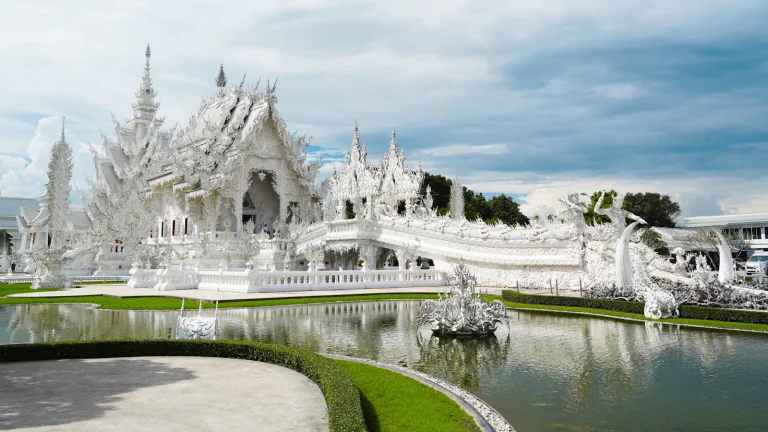
Doi Suthep pairs perfectly with a temple day in the city. My guide to the best temples in Chiang Mai covers Wat Chedi Luang, Wat Phra Singh, the forest temple Wat Umong and the silver temple. If you’re continuing north, the White Temple day trip to Chiang Rai is the obvious next step. For the bigger picture, see my roundup of the best temples in Thailand and the full Thailand travel guide. Chiang Mai is also great for adventure, so check the best ziplines in Thailand and the best waterfalls in Thailand, including the Sticky Falls.
Doi Suthep FAQ
How much does it cost to visit Doi Suthep?
Foreigners pay 30 baht to enter the temple. Add a small fee if you take the funicular, around 100 baht for a return songthaew in a full truck, and the national park fee if you hike the Monk’s Trail.
How many steps are there at Doi Suthep?
The naga staircase has about 306 steps (some signs say 309). Most people climb it in 10–15 minutes. There’s also a funicular if you’d rather not climb.
How long is the Monk’s Trail to Doi Suthep?
About 7 km one way with around 600 m of climbing. Allow 3–3.5 hours to the top with a stop at Wat Pha Lat. The first 2 km to Wat Pha Lat is the easy part.
Can I wear shorts to Doi Suthep?
Not above the knee. Cover your shoulders and knees, or rent a sarong at the entrance. Long trousers are the easiest option for both men and women.
What is the best time of day to visit Doi Suthep?
Early morning for fewer people and cooler air, or late afternoon for golden light on the chedi and city views. Avoid midday, when tour groups arrive and the marble gets hot.
Is Bhubing Palace worth adding?
Yes, if you like gardens and have your own transport. It’s about 20 minutes further up the road, but it often closes for part of the cool season when the royal family is in residence, so check first.
Do I need a guide for the Monk’s Trail?
No. The trail is well used and easy to follow if you stay on the main path. A guided hike is a nice option if you want context about the monks and the forest.

Written by
Miki Kokica
Travel blogger behind One Day Itinerary. I test every route myself and share honest, practical guides so you can plan better trips in less time.
Work with me Instagram