Hi, I’m Miki! When people picture Morocco they think of souks, riads and Sahara dunes, but the waterfalls in Morocco were the surprise of my research for this guide. The Atlas and the Rif mountains hide 110-metre cascades, turquoise pools in cedar forests and a natural rock bridge you can hike to from Chefchaouen. Most of them are easy day trips from the cities I’ve written about.
I want to be clear from the start: I’ve explored Marrakech, Chefchaouen and Essaouira, but I haven’t hiked to Ouzoud or Akchour myself (yet). So this guide is my homework for you: every figure below comes from the pages I read in November 2026, and where sources disagree, I say so. Moroccan waterfalls change a lot with the seasons, so check before you go.
Waterfalls in Morocco at a glance
| Waterfall | Region | Height | How to get there | Entry fee | Swimming? | Best time |
|---|---|---|---|---|---|---|
| Ouzoud Falls | Azilal, Middle/High Atlas | 110 m (3 drops) | ~2.5 h by car or tour from Marrakech | Free (boats extra) | Yes, in the pools | Spring; early morning |
| Akchour & God’s Bridge | Talassemtane NP, Rif | Main fall often quoted ~100 m (estimates vary) | ~45 min by grand taxi from Chefchaouen | No fee mentioned | Yes, cold pools | Spring, autumn |
| Setti Fatma (Ourika) | High Atlas | Seven cascades, not published | ~1–1.5 h from Marrakech | Free (guide optional) | Paddling at the first fall | Spring; weekdays |
| Paradise Valley | Near Agadir | Small cascades and pools | ~1 h from Agadir | None mentioned | Yes | Late winter–spring |
| Imouzzer cascades | Ida Outanane, above Agadir | Not published | Continue past Paradise Valley | None mentioned | Not recommended | After rain (Jan–Mar) |
| Ras el-Ma | Chefchaouen | Spring-fed stream | Walk from the medina | Free | Feet only | Any time |
| Oued Laou & Oued Iferten | Near Chefchaouen | Small cascades | By car from Chefchaouen | None mentioned | Yes, gentle | Summer |
| Oum Er-Rbia sources | Middle Atlas, near Khenifra | Not published | ~3 h by car from Fes | Small local toll | Not stated | Spring–autumn |
| Cascades Attiq | Tissint, near Tata | Not published | ~5 h by car from Agadir | None mentioned | Yes, deep pools | Cooler months |
“Not published” means none of the sources I checked gave a reliable figure. Fees and transport prices change, so treat them as a guide.
1. Ouzoud Falls: Morocco’s most famous waterfall
If you only see one waterfall in Morocco, make it Ouzoud (Cascades d’Ouzoud). The water drops about 110 metres in three main tiers into the gorge of the El-Abid river, in Azilal province, roughly 150 km north-east of Marrakech. Red cliffs, olive trees and wild Barbary macaques make it the classic day trip from the city.
How to get there
- From Marrakech by car: around 150–160 km, about 2.5 hours each way. Paid parking is available near the main falls.
- By tour: the easiest option. Day trips from Marrakech are sold from about €24–35 per person (checked November 2026), usually with hotel pickup and free time at the falls.
- By public transport: there’s no direct bus. Take a bus from Marrakech to Azilal or Beni Mellal, then a taxi to Ouzoud. Travellers who tried it say it’s slower and pricier than they expected.
The walk, fees and swimming
- Entry: there’s no ticket for the falls or the trail.
- The walk: a loop of about 45 minutes to an hour. The staircase from the village down to the base takes about 10 minutes (15 back up). A natural trail above the falls takes about 35 minutes back to the village. You can also hike further down the river to quieter cascades (about 2 hours return, moderate).
- Boats: small rafts take you close to the falls for a few dirhams. One traveller paid 20 MAD in 2019; check the price before you sit down. Expect to get wet!
- Swimming: allowed in the pools, but the water is cold and turns brown after rain. Quieter swimming spots are downstream.
Tips: arrive early; one couple who stayed overnight had the falls almost to themselves after sunrise, and the crowds built through the day. Keep food and water bags closed, because the macaques will grab them, and don’t touch or feed them. You can skip the horse photo offers too. If you have time, stay a night in the village and continue to the Bin el Ouidane reservoir, about 26 km away.
2. Akchour waterfalls and God’s Bridge (near Chefchaouen)
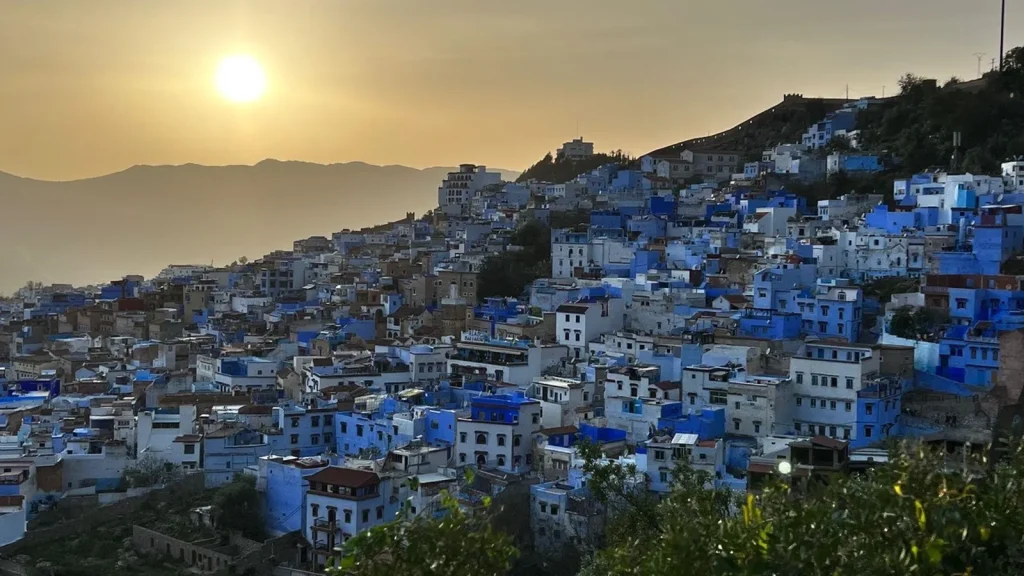
The Akchour falls are in Talassemtane National Park in the Rif mountains, about 30 km from Chefchaouen. Instead of one big drop, you follow a river canyon past swimming pools to two main waterfalls. A second trail leads to God’s Bridge (Pont de Dieu), a natural rock arch over the river. The main waterfall drops from a cliff often quoted at around 100 m, but estimates vary a lot, so take that as a rough idea.
How to get there
- Shared grand taxi: about 25 MAD per person each way from Chefchaouen (one guide updated in 2025) (checked November 2026). Taxis leave when they’re full (4–6 people), and the drive takes about 45 minutes.
- Private taxi: prices quoted by travellers range from about 250 MAD (arranged by a guesthouse) to 400 MAD. Agree on the return time before you go.
- Tours: day trips run from Chefchaouen and Tangier if you’d rather not sort out transport.
The hike
From the car park, you walk to a small hydro-electric dam where the trail splits. Right leads to God’s Bridge, about 45 minutes one way. Left crosses a bridge towards the waterfalls: about 1 hour to the small waterfall and about 2 hours to the big one (the Grande Cascade). The path is clear and you don’t need a guide, but it has steep stone steps. One hiker estimated about 7 km each way. Start early if you want to do both trails in one day.
- Fee: none of the guides I read mentions an entry fee; bring cash for cafés and the taxi (no card machines).
- Swimming: yes, in the pools in summer. The water is very cold.
- Best time: spring and after the autumn rains, when the falls are full. In summer the flow can be thin because water is used for irrigation.
- Good to know: the toilets are very basic, some shops only open around 11 am, and storms can roll in fast.
Akchour pairs perfectly with a day in the blue town itself: see my Chefchaouen one-day itinerary.
3. Setti Fatma: the seven cascades of the Ourika Valley
The closest waterfalls to Marrakech are above the village of Setti Fatma, at the end of the Ourika Valley, about 60 km south-east of the city. Seven cascades step up a rocky gorge in the High Atlas. Honest expectations: the falls are modest compared with the photos online, but the river, the mountain air and the tagine cafés make it a lovely half day. In my Marrakech guide I recommend the Ourika Valley as one of the best day trips.
- Getting there: about 1–1.5 hours by car. Shared grand taxis and minibuses leave from the Bab er-Rob area of Marrakech (about 20–50 MAD per seat; private taxi about 300–800 MAD) (checked November 2026).
- Fee: the trail is free. Licensed local guides (they wear ID badges) charge roughly 100–200 MAD per group (checked November 2026); agree the price before you start.
- The walk: about 30–45 minutes to the first waterfall, with stepping stones and small bridges. Above it, the path turns into a steep scramble over boulders, sometimes with fixed ropes. Most visitors stop at the first one or two falls.
- Best time: spring, when snowmelt makes the falls strongest. Go on a weekday morning; summer weekends are packed with day-trippers from Marrakech.
- Safety: the Ourika river can flood after heavy rain, especially from November to March. A flash flood in 1995 killed more than 100 people, so don’t go up if the river is running high.
Tip: politely refuse “helpers” who join you on the trail and ask for money at the top, and check your café bill before paying.
4. Paradise Valley: pools and small cascades near Agadir
Paradise Valley is part of the Tamraght river valley, in the hills above Agadir and Taghazout. It’s less about one big waterfall and more about rock pools, small cascades and natural water slides carved by the river. It’s one of the best places to swim in a river in Morocco.
- Getting there: take the N1 to Aourir, then the P1001 inland through Tamraght (look for the sign “La route d’Alma – Vallée du Paradis”). It’s about an hour from Agadir and roughly 20–30 minutes from Taghazout. Without a car, take city bus 31, 32 or 33 to Aourir (5 MAD), then a shared taxi (about 25 MAD) (checked November 2026).
- The walk: the regional tourism board says about 30 minutes on a signed footpath from the car park to the pools.
- Swimming: yes, and the pools are swimmable even when the river is low. Cliff jumping is discouraged in the dry months because of past accidents.
- Best time: late winter and early spring, when the river is full and the valley is green. Summer is dry.
Coming from Essaouira? Paradise Valley is about 3 hours south. It’s a great extra stop after my one day in Essaouira.
5. Imouzzer des Ida Outanane: the Bride’s Veil
Keep driving up the same road past Paradise Valley and you reach the Berber village of Imouzzer des Ida Outanane, at about 1,250 m. Below the village, water pours off the plateau in several streams down a cliff known as the Bride’s Veil.
- The catch: the falls only flow after rain. The regional tourism board says you can see them from January to March; Lonely Planet says your best chance is February to August. Ask locals if it has rained before you make the trip.
- The walk: signed trails lead down from the village; Lonely Planet describes a steep 4 km descent that’s pleasant even when the falls are dry.
- Swimming: the blue plunge pool looks tempting, but swimming isn’t recommended.
- Tip: politely but firmly decline unofficial “guides” at the start of the trail. Come on a Thursday for the weekly souk; the area is also known for its honey.
6. Ras el-Ma: the little cascades of Chefchaouen
You don’t need a car for this one. Ras el-Ma is the spring just outside the medina walls of Chefchaouen, where mountain water flows out of the hillside and locals traditionally came to wash their clothes. It’s free, and it’s a stop in my Chefchaouen itinerary: dip your feet in the cold water, then have a fresh orange juice at one of the little cafés (10–20 MAD). From here it’s a short walk up to the Spanish Mosque for sunset.
7. Oued Laou and Oued Iferten: family-friendly cascades
If you’re in Chefchaouen in summer and want an easy swim, the river valley of the Oued Laou is a local favourite. Take the P1405 from Al Oued for about 15 km to the bridge near Beni Ifertan. The Oued Iferten side stream has small cascades held back by stone dams, good for paddling. Straight ahead, the Oued Laou “familial” spot has a gentle entry with little current and a shingle beach with huts, which makes it good for young children. It’s popular with Moroccan families, so expect company on weekends.
8. The sources of the Oum Er-Rbia in the Middle Atlas
The Oum Er-Rbia river is born in the Middle Atlas, inside Aguelmam Azigza National Park near Khenifra. At its sources, a short path leads from a village to waterfalls at the head of the river, with open-air tea rooms and restaurants along the way.
- Getting there: it’s a road-trip stop rather than an easy day trip. One visitor needed about 3 hours by car to Fes (via Ifrane); it’s roughly 160 km south of Fes.
- The walk: about 1.5 km return (around 1 hour): 15 minutes from the car park to the village, then about 5 minutes past a bridge to the falls. It’s family-friendly.
- Fee: one visitor was asked by a local for a small toll at the bridge (in each direction), so carry small coins. That report is from 2015, so check before you go.
Combine it with a stay in Fes and a drive through Ifrane.
9. Cascades Attiq in Tissint: a desert waterfall
For something completely different, the salt-water cascades of Tissint sit in a desert village at the foot of Jbel Bani, about 70 km north-east of Tata. According to the regional tourism board, you can have a dip here, and local boys dive into the deep pools from the rocks.
- Getting there: about 5 hours by car from Agadir (N10 towards Taroudant, then the P1743 and the N12). In Tissint, head north on the N12 for about 600 m, take the first exit at the roundabout, park after about 75 m and walk to the metal handrail above the river.
- Best time: the cooler months; it’s a long, hot drive in summer.
How to plan a waterfall road trip in Morocco
The waterfalls are spread out, so plan them around your bases rather than trying to see them all:
- From Marrakech: Setti Fatma (half day) and Ouzoud (full day, or overnight). See my 3 days in Marrakech.
- From Chefchaouen: Akchour and God’s Bridge (full day), Ras el-Ma (an hour), Oued Laou in summer.
- From Agadir or Taghazout: Paradise Valley and Imouzzer in one day.
- On a longer loop: the Oum Er-Rbia sources between Fes and Beni Mellal, then Ouzoud on the way to Marrakech.
If you’re following my 10-day Morocco itinerary, Ouzoud and the Ourika Valley fit as extra days around Marrakech, and Akchour fits after Chefchaouen. Trains don’t reach any of these falls, so you’ll use grand taxis, a rental car or a tour. You’ll find all the basics on trains, money and scams in my Morocco travel guide, plus the capital in one day in Rabat.
Best time to see waterfalls in Morocco
March to May is the sweet spot: the rains and Atlas snowmelt fill the rivers, the valleys are green and it isn’t too hot to hike. Autumn (after the first rains) is the second-best window, especially for Akchour. In summer the swimming is great, but many falls shrink, Imouzzer can dry up completely and Ourika and Ouzoud are at their busiest. Winter (November to March) can bring plenty of water, but also the highest flash-flood risk in the mountain valleys.
What to pack
- Shoes with good grip (or sturdy hiking sandals): the rocks by the falls are slippery
- Swimsuit and a quick-dry towel; dress modestly in villages and wear a cover-up over your swimsuit away from the water
- Cash in small dirhams for taxis, cafés, boats and tolls
- Water and snacks, especially for Akchour and the upper Setti Fatma falls
- A light jacket: mountain valleys are cooler than the cities
- A dry bag for your phone (Ouzoud’s spray soaks everything)
Safety at Moroccan waterfalls
- Flash floods: mountain rivers can rise fast after rain higher up in the mountains, even if it’s sunny where you are. Avoid riverbeds and gorges after heavy rain, especially from November to March.
- Slippery rocks: most accidents happen on wet stone. Take the upper scrambles at Setti Fatma slowly, and skip cliff jumping unless you know the depth.
- Monkeys: Barbary macaques are wild. Don’t feed or touch them.
- Unofficial guides: agree prices before anyone “helps” you, and use licensed guides with ID.
Insider tips
- Arrive early at Ouzoud and Setti Fatma: the tour groups arrive late morning.
- Go on a weekday; Moroccan families fill the riverbanks on weekends.
- At Ouzoud, ignore anyone steering you to a “better” restaurant; many have views, and set menus can be good value.
- At Akchour, ask your guesthouse to book a return taxi, and don’t leave it too late in the day.
- Before driving to Imouzzer or Paradise Valley, ask locals whether it has rained recently.
Planning more waterfall trips? See my guides to the waterfalls in Spain (just a ferry away), Portugal, Jordan, Kenya and Turkey, or the waterfalls of Iceland and Bali. For more of the region, see my Spain travel guide.
Morocco waterfalls FAQ
What is the biggest waterfall in Morocco?
Ouzoud Falls is the best-known and highest, at about 110 metres in three main drops, in Azilal province about 150 km from Marrakech.
Is there an entrance fee for Ouzoud Falls?
No. Visitors in 2019 and 2026 report no ticket for the falls or the trail. You pay extra for parking, boat rides, guides and food.
Can you swim at Ouzoud Falls?
Yes, swimming is allowed in the pools, but the water is cold and can be brown after rain. Quieter spots are downstream from the main falls.
How do I get to the Akchour waterfalls from Chefchaouen?
Take a shared grand taxi (about 25 MAD per person each way in 2025) or a private taxi. The drive takes about 45 minutes, then you hike about 1 hour to the small waterfall or 2 hours to the big one.
Which waterfall is closest to Marrakech?
The Setti Fatma cascades in the Ourika Valley, about 60 km and 1–1.5 hours from Marrakech. The first waterfall is a 30–45 minute walk from the village.
When is the best time to see waterfalls in Morocco?
March to May, when rain and snowmelt fill the rivers. Some falls, like Imouzzer near Agadir, only flow after rain and can be dry in summer.
Are there waterfalls near Agadir?
Yes. Paradise Valley has pools and small cascades about an hour from Agadir, and the seasonal Imouzzer falls are further up the same road.

Written by
Miki Kokica
Travel blogger behind One Day Itinerary. I test every route myself and share honest, practical guides so you can plan better trips in less time.
Work with me Instagram