Croatia surprises a lot of divers. People come for the old towns and the islands, then discover that the Adriatic hides some of the best wreck diving in Europe. There are World War I liners, Allied bombers, cargo ships still full of coal, and walls covered in red and yellow gorgonians. Having travelled up and down this coast and around most of the islands, I’d say scuba diving in Croatia is worth planning a trip around, especially if you’re an Advanced diver or working towards it.
Honest expectations: there’s no tropical coral and few big animals. You get excellent visibility around the islands (often 15–20 m or more in Dalmatia), dramatic topography, history and lots of macro life. The surface reaches 22–26°C in summer, but it’s colder below the thermocline, so most divers wear 5 mm or more. Many headline wrecks sit at 25–40 m, which suits certified divers best, but every region has easy reefs for courses and try-dives.
Croatia dive sites at a glance
| Spot | Area | Level | Depth | How to get there | Best for |
|---|---|---|---|---|---|
| Baron Gautsch | Rovinj, Istria | Advanced + deep | 28–39 m | Licensed centre boat | Historic wreck |
| Banjole island | Rovinj, Istria | Beginner–advanced | 5–35 m | Boat from Rovinj | Caves, wall |
| HMS Coriolanus | Novigrad, Istria | Advanced | 17–30 m | Boat from Novigrad area | WWII wreck |
| Fraškerić and the Vis wreck | Kamenjak, Istria | Beginner–advanced | 3–32 m | Boat from Premantura/Medulin | Tunnels, easy wreck |
| Lina wreck | Rabac–Cres, Kvarner | Advanced | 20–55 m | Boat from the Rabac area | Steamship wreck |
| Kornati walls | Kornati National Park | Intermediate–advanced | Walls to 40 m (limit) | Licensed centre with park permit | Walls, clear water |
| Lučice cave | Brač | Experienced | Entrance ~3 m, below 30 m inside | Boat from Bol | Cave dive |
| Kampanel and Vodnjak | Pakleni Islands, Hvar | Experienced | 10–40 m+ | Boat from Hvar | Gorgonians, pinnacle |
| Vis wrecks | Vis | Advanced to technical | 10 m to 70 m+ | Boat from Komiža or Vis | Wrecks, aircraft |
| Taranto | Dubrovnik | Advanced | 23–55 m | Licensed centre boat | WWII wreck |
Depths are for the whole site. Recreational air diving in Croatia is capped at 40 m, and the deeper parts of some wrecks need technical training.
1. Baron Gautsch, Rovinj: Croatia’s most famous wreck
The Austro-Hungarian passenger steamer Baron Gautsch struck a mine in August 1914, about 9 nautical miles off Rovinj, and sank within minutes. It’s remembered as the worst Adriatic sea tragedy of World War I, and every 13 August there’s a memorial dive and wreath-laying. The 85–89 m ship sits upright and is well preserved, with the shallowest parts at around 28 m and the seabed just under 40 m.
This is protected cultural heritage. You can only dive it with centres that hold a special Ministry of Culture permit, and penetration is limited to the first two decks.
- How to get there: Boat trips with licensed centres from Rovinj and other west Istrian resorts.
- Level/depth: 28–39 m. At least one Rovinj centre asks for Advanced plus a deep specialty and a minimum of 50 logged dives.
- What you’ll see: Decks, portholes and sponge-covered superstructure, with fish schools around the hull.
- Tip: Expect an extra permit ticket per dive, about €12.50 on one Rovinj centre’s list. Nitrox helps with bottom time.
2. Banjole island, Rovinj: caves for every level
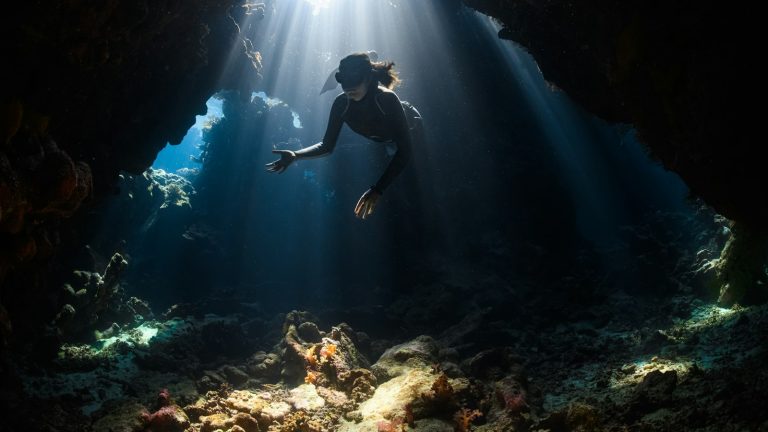
Banjole (Banjol) is a small islet near Rovinj and a favourite with local centres because it suits beginners and deep divers on the same boat. A cave entrance at about 5 m leads into a central chamber lit by sunlight from an opening above. There are two more caves at about 12 m, and a wall runs between roughly 28 and 32 m.
- How to get there: A short boat ride from Rovinj.
- Level/depth: 5–30 m (up to about 35 m on the reef). A torch is recommended.
- What you’ll see: Red starfish, sea cucumbers, scorpionfish, lobster and schools of mullet.
- Tip: A good first “cave” for Open Water divers, as long as you stay with a guide.
3. HMS Coriolanus, Novigrad: a British minesweeper
West of Novigrad lies HMS Coriolanus, a Royal Navy Shakespeare-class minesweeper that hit a mine in May 1945. It’s about 50 m long and sits between roughly 17 and 30 m, with guns still visible. Summer plankton can reduce visibility.
- How to get there: Boat dives from centres around Novigrad and Umag.
- Level/depth: 17–30 m, Advanced level. Interior entry is for technical divers only.
- What you’ll see: Cannons, deck fittings and plenty of marine growth.
- Tip: Spring and autumn usually give the clearest water here.
4. Fraškerić and the Vis wreck, Kamenjak: easy tunnels and Tito’s ship
The islet of Fraškerić has tunnels with light shafts between about 3 and 26 m and counts as an easy site. Nearby, off the Kamenjak peninsula, the former Yugoslav Navy command ship Vis was deliberately sunk as a dive attraction. Built in Pula in 1956 and used by Tito, the 58 m ship rests upright at 32 m, and its upper decks are within reach of beginners diving to 20 m.
- How to get there: Boats from Premantura and Medulin, about 10 km from Pula.
- Level/depth: 3–26 m at Fraškerić and 20–32 m on the wreck.
- What you’ll see: Light shafts, small caves and fish schools in the ship’s saloons.
- Tip: A great area for an Open Water course with a “first wreck” at the end.
5. Lina wreck, Kvarner: a steamship below the cliffs
The Lina was a British-built iron steamship from 1879 that ran onto the cliffs in dense fog and a storm in 1914. It lies between Rabac on Istria’s east coast and Cape Pečen on Cres, and it’s one of the most visited wrecks in the Adriatic. It sits on a slope from about 20 to 55 m, so you can tailor the dive to your training.
- How to get there: Boat trips from centres around Rabac.
- Level/depth: 20–55 m, Advanced Open Water at minimum.
- What you’ll see: Hull plates, the bow on the slope and encrusting life.
- Tip: Agree a depth limit with your guide before the dive, because the wreck keeps going.
6. Kornati National Park walls: diving the “crowns”
The Kornati’s sheer seaward cliffs (the “crowns”) keep dropping underwater. The underwater part of the Klobučar crown goes down to about 90 m, far beyond recreational limits. The park has one of Croatia’s largest coralligenous habitats and usually very clear water. Scuba diving here needs a permit and a licensed centre, so you can’t just go on your own.
- How to get there: With licensed North Dalmatian dive centres that hold park permits.
- Level/depth: Intermediate to advanced wall diving, within 40 m.
- What you’ll see: Coralligenous walls, sponges and fish life.
- Tip: Nearby Telašćica Nature Park on Dugi Otok allows diving only at a few designated sites, also with a permit.
7. Lučice cave, Brač: stalactites underwater
Off south-west Brač, the Lučice cave opens at about 3 m and leads into large chambers that go below 30 m. The stalactites and stalagmites formed when the cave was above sea level, and the walls have red coral and colourful growth. Dive centres in Bol run it as a full-day trip for experienced divers, and big groupers have been reported inside.
- How to get there: Boat excursions from Bol.
- Level/depth: Experienced divers only. The entrance is shallow, but the chambers are deep.
- What you’ll see: Stalactites, red coral and groupers.
- Tip: Bol’s local sites include Babice stine, a shallow 5–6 m dive over the remains of a Roman villa.
8. Kampanel and Vodnjak, Pakleni Islands: gorgonian walls off Hvar
Divers often call the seabed around the Pakleni Islands one of the most beautiful in the Mediterranean, and its western cliffs are the reason. Kampanel is a narrow, tower-like rock that rises from about 46 m to 15 m below the surface and is densely covered in gorgonians. Vodnjak, south-west of Hvar, has a reef top at around 10 m and a southern cliff covered in red and yellow gorgonians.
- How to get there: Boat dives from Hvar Town, or full-day trips from Bol.
- Level/depth: Experienced divers. Tops start at 10–15 m, but the walls drop well below 40 m.
- What you’ll see: Gorgonian forests, fish shoals and shellfish.
- Tip: Buoyancy control matters here. Gorgonians break easily.
9. Vis wrecks: Teti, Vassilios T and the bombers
The Teti (a steamship lost near Komiža in 1930) runs from about 10 to 33 m and has big conger and moray eels. The Greek coal steamer Vassilios T, which ran aground in 1939, lies on its side from about 22 to 55 m. The B-24 Liberator “Tulsamerican” sits at about 37–52 m, and the B-17 Flying Fortress lies at about 72 m. Both are for trained technical divers.
- How to get there: Centres in Komiža and Vis town. The ferry from Split takes about 2 hours 20 minutes, and the catamaran is faster.
- Level/depth: Teti and the upper Vassilios T suit Advanced divers. The aircraft and deeper wrecks are technical dives.
- What you’ll see: Wrecks covered in sponges, eels, lobsters and scorpionfish. Nearby reefs have red gorgonians.
- Tip: Ask for nitrox or trimix when you book. Some wrecks carry extra fees.
10. Taranto, Dubrovnik: the southern classic
The Italian merchant ship Taranto hit a mine near Dubrovnik in 1943 and broke in two. The stern lies deeper and partly buried, and the bow tilts at around 45 degrees, at depths of about 23–55 m. You can still see cargo remains, including tractor parts. It’s protected, so only licensed centres take divers here.
- How to get there: Boats from Dubrovnik dive centres.
- Level/depth: 23–55 m, advanced.
- What you’ll see: Sponges, soft growth, sea bass and octopus around the cargo.
- Tip: Near Cavtat, an ancient amphora wreck at 25–30 m is protected under a metal lattice. It’s another licensed-centre dive.
Diving rules and permits in Croatia in 2027
Older guides often describe rules that have since changed. This is how it works according to the official government guidance, but confirm with your dive centre before you travel.
- Diving with a registered dive centre: This is the simple route. Bring your certification card (and logbook for deep or wreck dives) and fill in the centre’s medical and liability forms. Some centres ask older divers for a recent doctor’s certificate.
- Independent diving: You need an individual diving authorisation from a Harbourmaster’s Office (Pula, Rijeka, Senj, Zadar, Šibenik, Split, Ploče or Dubrovnik). It costs around €318 and is valid for a year. You must mark your dive with an orange or red buoy at least 30 cm across, or a diver-down flag.
- Protected wrecks and archaeological zones: Sites like the Baron Gautsch, Taranto and the Cavtat amphora wreck can only be dived through centres with a Ministry of Culture permit, and you’ll often pay a permit ticket per dive.
- National parks: Kornati and Mljet need park permits and licensed centres. Brijuni allows organised diving only, and Krka is off-limits.
- No-go zones: Ports, harbour entrances, anchorages, busy shipping lanes, the area within 100 m of military vessels, and reserves like the Lim Channel.
- Depth and finds: Recreational air diving is limited to 40 m. If you spot an archaeological find, leave it and report its location.
Best time for diving in Croatia in 2027
Most centres run from about May to October, and some open in April or stay open into November. Surface temperatures in Split average about 18°C in May, 22°C in June, 24–25°C in July and August, 24°C in September and 20–21°C in October. Below 20–30 m it stays much colder, around 16–19°C even in summer.
September and October are my picks: the water is still warm, the boats are quieter and visibility is usually excellent. In Istria, visibility is often best in spring and autumn, because summer plankton and algae can cloud the water. In Dalmatia and around the islands, 15–20 m is common and Vis can be much clearer. Strong bura or jugo winds can cancel boat dives at any time of year.
Courses, prices and how to book
- Fun dives: On one Rovinj centre’s list, a single boat dive costs around €38–50 and a double around €66–90. Prices elsewhere are similar.
- Try dive: Around €75 for a supervised first dive with all the equipment.
- Open Water course: Roughly €450–550, depending on the agency and the centre.
- Advanced course: Around €340–360.
- Extras: Permit tickets for protected wrecks, nitrox or trimix, full equipment rental (around €20–25 per dive) and boat fees for distant sites.
- What to look for: PADI or SSI centres with permits for the protected sites you want, small groups and well-maintained equipment. Ask whether the price includes the permit ticket.
What to pack
- Your certification card and logbook (or app)
- A 5 mm wetsuit or more, plus a hood for deep dives or the shoulder season
- Your own mask and computer, and a torch for caves and wrecks
- An SMB (surface marker buoy)
- Proof of dive insurance
- Reef-safe sunscreen and a warm layer for the boat ride back
Safety tips
- Get dive insurance and check that it covers your planned depth and wreck dives.
- Don’t fly too soon. Follow the common guidance of waiting around 18–24 hours after your last dive before flying.
- Respect your training limits. Many Croatian wrecks go deeper than they look from the top. Do a deep specialty first if you need one.
- Never penetrate wrecks or caves without training and a guide.
- Use an SMB. Boat traffic in summer is heavy.
- Know where help is. Recompression chambers are in Pula, Split and Komiža. The EU emergency number is 112, and 195 is the maritime search and rescue line.
- Look, don’t touch. Gorgonians, red coral and archaeological material are protected.
Scuba diving in Croatia FAQ
Do I need a permit to scuba dive in Croatia?
If you dive with a registered dive centre, you normally only need your certification card. Independent divers need an individual diving authorisation from a Harbourmaster’s Office, costing around €318 a year.
Is Croatia good for beginner divers?
Yes. Calm, clear bays around Rovinj, Pula, Hvar and Dubrovnik are great for try-dives and Open Water courses. Most of the famous wrecks need Advanced training, though.
What is the best wreck dive in Croatia?
The Baron Gautsch off Rovinj is the most famous, and Vis has the greatest concentration of wrecks, including World War II aircraft for technical divers. Taranto is the classic near Dubrovnik.
How cold is the water for diving in Croatia?
The surface reaches around 24–26°C in July and August, but at depth it’s closer to 16–19°C. A 5 mm wetsuit is standard, and many people add a hood in spring and autumn.
Can I dive in Croatian national parks?
Only under conditions. Kornati and Mljet need permits and licensed centres, Brijuni allows organised dives only, and Krka is closed to diving.

Written by
Miki Kokica
Travel blogger behind One Day Itinerary. I test every route myself and share honest, practical guides so you can plan better trips in less time.
Work with me Instagram