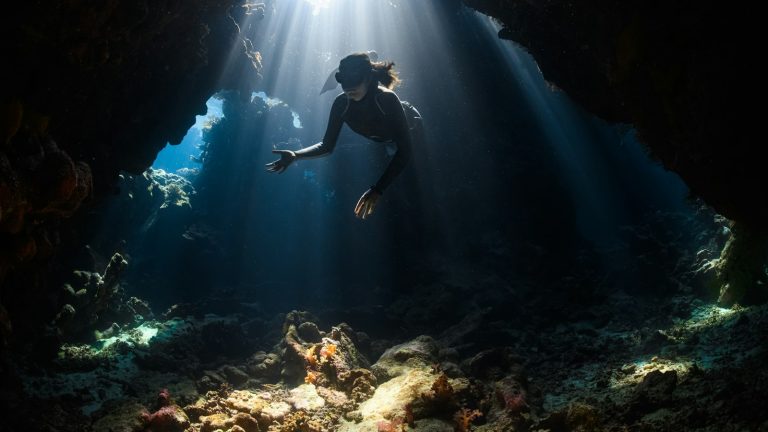
Crete is the biggest Greek island and also the warmest, with more than 1,000 km of coastline split between the Cretan Sea in the north and the Libyan Sea in the south. That makes it brilliant for snorkeling in Crete. When the wind blows on one coast, there’s usually a sheltered bay somewhere else. In one week you can float over a sunken ancient city, snorkel the rocky edges of a pink-sand lagoon and take a boat to a village with no road. If you’re certified, you can even dive into a cave full of elephant fossils.
What to expect: very clear water, rocky reefs, seagrass and caves rather than coral. You’ll see wrasse, bream, damselfish, octopus and moray eels, and with luck a turtle. The sea is the warmest in Greece, around 25–27°C in July and August, and swimmable from May to November. Most spots below suit beginners on calm days, and I’ve flagged the ones better for confident swimmers.
Snorkeling in Crete at a glance
| Spot | Area | Level | Depth | How to get there | Best for |
|---|---|---|---|---|---|
| Agia Pelagia & Mononaftis | Heraklion | Beginner | Sand at 2–3 m, deeper off the rocks | Car or bus from Heraklion | Easy snorkel, learn to dive |
| Elounda & Olous | Lasithi | Beginner | Shallow | Car from Agios Nikolaos | Sunken ruins |
| Schinaria (Skinaria) | Rethymno south coast | Intermediate | Deep, clear water close to shore | Car via Lefkogia | Visibility, moray eels |
| Elafonissi | Chania southwest | Beginner | 0.5–5 m | Car (about 1 h 15 from Chania) | Families, pink sand |
| Balos & Gramvousa | Chania northwest | Intermediate | Lagoon 0.5–1.5 m, coast to 10 m | Boat from Kissamos or rough road | Scenery |
| Matala | Heraklion south | Beginner–intermediate | Shallow near shore, deeper off the rocks | Car | Roman port remains |
| Loutro & Sfakia coast | Chania south | Beginner–intermediate | Shallow near shore, deeper off the rocks | Ferry from Chora Sfakion or Paleochora | Car-free coves |
| Elephant Cave | Akrotiri, Chania | Experienced divers | Entrance at 10 m | Boat dive | Fossils, stalactites |
Depths are typical for the areas most people snorkel. Wind changes everything in Crete, so check the forecast for each coast.
1. Agia Pelagia and Mononaftis, Heraklion: the easy all-rounder
Agia Pelagia is a resort village about 25 km west of Heraklion, set in a sheltered bay with usually calm, clear water. The middle of the bay is sandy at 2–3 m. The fun is along the rocky sides, where fish gather around the boulders (and so do sea urchins). Next door, little Mononaftis Bay and the coves around the headland add reefs, small caves and moray eels.
This is also one of Crete’s longest-established diving areas. Several PADI and SSI centres run try-dives, courses and boat trips from here, including trips to Dia Island off Heraklion. If anyone in your group wants to try scuba while the rest snorkel, this is the place.
- How to get there: About 30 minutes by car or bus from Heraklion.
- Level/depth: Beginner. Sandy entry, with deeper water off the rocks.
- What you’ll see: Wrasse, bream, octopus, moray eels in the cracks, lots of urchins.
- Tip: Beach bars rent masks for a few euros, but bring water shoes for the rocks.
2. Elounda and Olous, Lasithi: snorkel over a sunken city
The ancient city of Olous now lies partly under the sea near Elounda, by the causeway that links the mainland to the Spinalonga (Kalydon) peninsula. In calm, clear, shallow water, you can float over the outlines of submerged walls and foundations. It’s one of the most memorable easy snorkels in Greece, and children love the treasure-hunt feeling.
The coves on the peninsula, including Kolokytha, which you reach on a rough track, add sand-and-rock seabeds with fish and octopus. Elounda is also the starting point for boats to Spinalonga island.
- How to get there: About 10 km north of Agios Nikolaos by car. Park near the causeway.
- Level/depth: Beginner, shallow water.
- What you’ll see: Ancient walls, seagrass, small fish.
- Tip: Look, don’t touch, and never take anything. Underwater antiquities are protected by law in Greece.
3. Schinaria (Skinaria), Rethymno: the clearest water on the south coast
Schinaria, also spelled Skinaria, is a small cove about 33 km south of Rethymno, near the village of Lefkogia in the Plakias area. The water is deep, clear and turquoise, often with 40 m of visibility, over a mostly rocky seabed. It’s also a popular dive site, and many Cretan dive centres include it in their programmes.
There’s a taverna with a few umbrellas, and freshwater springs feed small ponds behind the beach. Nearby Plakias, Damnoni and Souda have more beaches, and rocks at their edges for snorkeling.
- How to get there: By car via Lefkogia, then a narrow 2 km road down to the beach.
- Level/depth: Intermediate. It gets deep fairly quickly.
- What you’ll see: Large moray eels, octopus, bream, rocky reef.
- Tip: It gets busy in summer. Arrive early and snorkel along the left and right rocks.
4. Elafonissi, Chania: pink sand and shallow lagoons
Elafonissi in the far southwest of Crete is famous for its pink-tinged sand and very shallow lagoon. The lagoon is 0.5–1.5 m deep, warm and perfect for little ones, but there’s not much to see. For snorkeling, wade across the shallow channel to the islet and swim along its rocky outer side, where outcrops reach 4–5 m and attract wrasse, damselfish and other fish.
It’s a protected Natura 2000 area, so don’t take sand or shells, and stay on the paths through the dunes.
- How to get there: About 75 km from Chania (around 1 h 15 by car). There are also day buses and boat trips from Paleochora.
- Level/depth: Beginner.
- What you’ll see: Rocky outcrops, small fish, amazing colours.
- Tip: Get there before 9.30am. By 11am in high season it’s crowded.
5. Balos and Gramvousa, Chania: the postcard lagoon
Balos is Crete’s most photographed lagoon, a swirl of white sand and turquoise shallows at the tip of the Gramvousa peninsula. But the lagoon itself is only 0.5–1.5 m deep, so it’s not real snorkeling. The better water is off the open-sea rocks north and east of the cape, where the seabed drops to around 10 m and you might see groupers and bream.
The boat trip from Kissamos is the easiest way. It usually stops at Gramvousa island, with its Venetian fortress, before Balos.
- How to get there: Cruise from Kissamos port. Or drive the rough track (a 4×4 helps), pay for parking and walk about 20 minutes down.
- Level/depth: Intermediate for the open-sea rocks.
- What you’ll see: Rocky reef, fish, stunning colours from the surface.
- Tip: Skip it on strong north wind days. The open coast gets rough and visibility drops.
6. Matala, Heraklion south: caves and a Roman harbour
Matala is famous for the ancient caves carved into its sandstone cliffs, which were once home to 1960s hippies. Underwater, there are remains of the Roman-era port on both sides of the rocks, and the bay is known for good swimming and snorkeling. Moray eels hide in the rocky cracks.
Combine it with a visit to Phaistos, and with the quieter beaches nearby, such as Red Beach (a short hike).
- How to get there: About 1 h 15 by car from Heraklion.
- Level/depth: Beginner to intermediate.
- What you’ll see: Rocks, moray eels, remains of ancient harbour structures.
- Tip: Swim along the edges of the bay, away from the swimming area in the middle.
7. Loutro and the Sfakia coast, Chania: car-free coves
Loutro is a tiny white village on Crete’s south coast that you can only reach by ferry or on foot. Around it, the coast of Sfakia has pebble coves with very clear water and rocky seabeds. You can swim straight from the village, rent a kayak, or take a water taxi to coves like Sweetwater and Marmara.
This is wild coast backed by the White Mountains. If you like snorkeling far from crowds and roads, it’s one of my favourite picks in Crete.
- How to get there: Ferry from Chora Sfakion or Paleochora. The Chora Sfakion ferry is short.
- Level/depth: Beginner to intermediate.
- What you’ll see: Rocky reef, bream, wrasse, very clear water.
- Tip: Facilities in the remote coves are limited, so take water, shade and snacks.
8. Elephant Cave, Akrotiri: a dive for certified divers
This one is for divers, not snorkelers, but it’s too special to leave out. On the Akrotiri peninsula east of Chania, a snorkeler discovered a sea cave in 1999. The entrance starts about 10 m below the surface. A tunnel of about 40 m leads to a large chamber with red and white stalactites and the fossilised bones of an extinct elephant, estimated at 50,000–60,000 years old.
The stalactites are fragile and still forming, so excellent buoyancy is essential. Local dive centres around Chania organise trips and decide who’s experienced enough.
- How to get there: Boat dive with a Chania-area dive centre.
- Level/depth: Experienced divers with good buoyancy. The entrance is at about 10 m.
- What you’ll see: Cave formations, fossils, an air chamber inside.
- Tip: It depends on calm sea conditions, so leave spare days in your plan.
Best time for snorkeling in Crete in 2027
Crete has the longest season in Greece. The water stays at 20°C or above from about May to November.
- May: Around 20°C. Fresh, and a shorty wetsuit helps.
- June: Around 22–23°C. Great visibility and fewer crowds.
- July–August: Around 25–27°C, and August is warmest. These are the busiest months, and the northern meltemi wind can make the north coast choppy.
- September–October: Still 22–25°C, with calmer beaches. My favourite time.
- November–April: Around 16–18°C. It’s possible on calm sunny days with a 5 mm wetsuit, but many tours close from late October.
The rule of thumb: when the north wind blows, look at sheltered bays like Agia Pelagia and Almyrida, or try the south coast, and check the forecast for gusts there too.
Prices and how to book
- Beach snorkeling: Free. Mask rental at beach bars costs a few euros, and parking at Elafonissi and Balos costs a few euros too.
- Boat trips: Balos and Gramvousa cruises from Kissamos, Loutro ferries and Spinalonga boats from Elounda all run daily in season. Book Balos ahead in August.
- Try-dive (Discover Scuba Diving): From around €65–90 in Agia Pelagia, often a bit more elsewhere.
- PADI Open Water course: From around €500–550.
- Fun dives and specialty sites: Elephant Cave dives are priced by each centre. Ask about the experience requirements first.
- How to book: Choose a PADI or SSI centre with small groups and good reviews for briefings and gear. For snorkel boats, check what’s included (gear, lunch, how many stops).
These are rough 2027 guides. Prices change by season and operator.
What to pack
- Your own mask and snorkel, plus fins for Schinaria and boat trips
- Water shoes, because Crete’s rocks are full of sea urchins
- A rash guard or shorty wetsuit
- Reef-safe sunscreen, a hat and a beach umbrella for remote coves
- Plenty of water and snacks. Remote beaches have few facilities.
- A dry bag and a waterproof phone pouch
- A surface buoy for snorkeling near boat traffic
Safety tips
- Check the wind for each coast. Crete’s weather can be calm on one side and rough on the other.
- Stay away from boat channels, especially at Balos, Elafonissi and Elounda. Use a buoy.
- Don’t swim into caves when there’s swell.
- Watch for black sea urchins and, on some days, jellyfish.
- Keep your distance from turtles and monk seals, and never feed fish.
- Don’t take anything from archaeological sites, on land or underwater.
- If you dive, check your insurance covers diving, and allow at least 18–24 hours before flying.
Crete snorkeling FAQ
Is Crete good for snorkeling?
Yes. It has the warmest water in Greece, a long season and a huge variety of coves. Expect rocky reefs, caves and ruins rather than coral.
Where is the best snorkeling in Crete for beginners?
Agia Pelagia, Elounda (Olous) and Elafonissi have calm, shallow water and easy entries.
Can you snorkel at Balos Lagoon?
The lagoon itself is too shallow for real snorkeling. The rocks on the open-sea side and Gramvousa island are better on calm days.
Can you see turtles when snorkeling in Crete?
Sometimes. Loggerhead turtles nest on some Cretan beaches and are occasionally seen around the island. Keep your distance if you meet one.
Is there scuba diving in Crete?
Yes, and plenty of it. Agia Pelagia, Chania, Plakias and Agios Nikolaos all have dive centres, with sites ranging from easy reefs to the Elephant Cave.
When is the water warmest in Crete?
August, at around 26°C on average. September and October are still very warm.

Written by
Miki Kokica
Travel blogger behind One Day Itinerary. I test every route myself and share honest, practical guides so you can plan better trips in less time.
Work with me Instagram