Lakes are the thing I keep coming back to in Europe. A clear mountain lake early in the morning, before the boats start and the day-trippers arrive, is the moment I remember from a trip. This list of the most beautiful lakes in Europe mixes places I’ve written full country guides about with a few famous ones I haven’t covered in depth yet.
I’ll be upfront about that difference. Where I have a country guide on this site, I link to my full lake roundup for that country. Where I don’t (Slovenia, Switzerland and North Macedonia), I tell you what I’d tell a friend and what the official sites say, without pretending I’ve done every walk. Prices and timetables were checked in November 2026.
The most beautiful lakes in Europe at a glance
| Lake | Country | Why go | How to get there | Key cost* | Swimming? | Best time |
|---|---|---|---|---|---|---|
| Plitvice Lakes | Croatia | 16 lakes, 78 m waterfall | Bus from Zagreb, about 2 h 20 min | €10–40 park ticket | No | May–Jun, Sep–Oct |
| Lake Bled | Slovenia | Island church, castle | 55 km from Ljubljana | Pletna €20, island €12 | Yes, in summer | May–Sep |
| Lake Como | Italy | Villas, ferries, mountains | Train Milan–Varenna, 64 min | Ferry fares vary | At lidos | Apr–Jun, Sep |
| Hallstätter See | Austria | Village on the water | Train to Hallstatt, then ferry | Ferry €4 one way | Check locally | Early mornings, all year |
| Lake Bohinj | Slovenia | Quiet, wild, Triglav NP | Car or bus from Bled | Savica waterfall €4 | Yes, cold | Jun–Sep |
| Oeschinensee | Switzerland | Alpine lake under cliffs | Gondola from Kandersteg | CHF 36–40 return | Check before you go | Late Apr–Sep |
| Lake Ohrid | North Macedonia, Albania | One of the oldest lakes on earth | Ohrid town and airport | Free | Yes | Jun–Sep |
| Sete Cidades | Portugal (Azores) | Blue and green crater lakes | Car on São Miguel | Free | Check before you go | Clear days, any season |
| Lagos de Covadonga | Spain | Mountain lakes in Picos de Europa | Bus from Cangas de Onís | Bus €9 | Check before you go | Jun–Oct |
| Pliva lakes | Bosnia and Herzegovina | Watermills and a town waterfall | Car to Jajce | Mills free | Yes | May–Sep |
| Lake Hévíz | Hungary | Thermal lake, swim all year | Car from Keszthely, 8 km | 3,000 HUF | Yes | Nov–Mar |
| Lake Kournas | Greece (Crete) | Crete’s only natural freshwater lake | 47 km from Chania | Free | Yes | May–Oct |
*Adult prices from official websites (checked November 2026). Some 2027 prices hadn’t been published yet, so I give the latest official ones.
1. Plitvice Lakes, Croatia
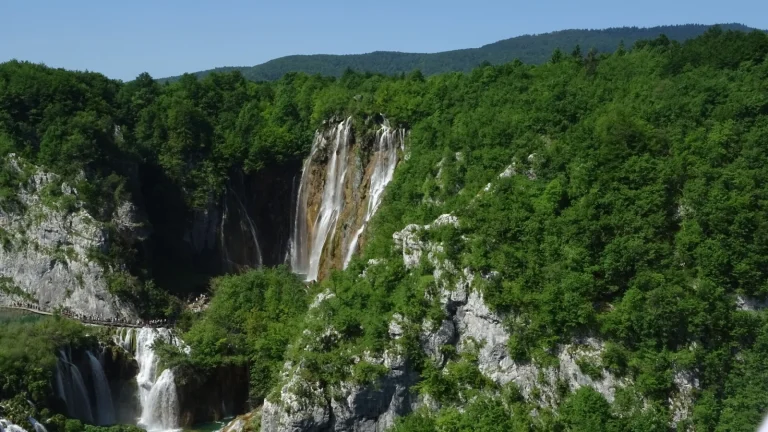
I’ve been to Plitvice in different seasons, and it still stops me every time. It’s a chain of lakes stepping down through the forest, joined by travertine barriers and waterfalls, with wooden boardwalks running right over the water. Sixteen lakes are visible from the surface, split into the Upper and Lower Lakes, and at the end of the Lower Lakes the Plitvica stream drops 78 m in Veliki slap, the tallest waterfall in Croatia. It’s been a UNESCO World Heritage Site since 1979.
- How to get there: buses from Zagreb take about 2 h 20 min and from Zadar about 2 hours. Stay a night nearby if you’re coming from Split.
- Fee: adults €40 from June to September (€25 after 16:00) and €10 from November to March (checked November 2026). Book a time slot online in summer.
- Swimming: strictly no, anywhere in the park.
- Best time: May and June for full waterfalls, or October for autumn colours. Arrive at opening time.
Plitvice is the centrepiece of my 4 days in Croatia itinerary. For more Croatian lakes, see my full guide to the best lakes in Croatia.
2. Lake Bled, Slovenia
Bled is the lake everyone pictures when you say “Europe”, and it’s high on my list for a proper visit. What I tell friends is simple: it’s small, so you can see it in a day. The lake is about 2.1 km long and 1.4 km wide, at 475 m, with a tiny island and its church in the middle and a castle on the cliff above. It’s only 55 km from Ljubljana and 35 km from the airport.
The classic way to the island is a pletna, the traditional wooden boat. Then you climb the 99 stone steps to the church and ring the wishing bell.
- Pletna: €20 per person return, €10 for children 4 to 12. Boats leave from Kazina, Mlino, Vila Bled and Velika Zaka when they’re full; from May to September they run 10:00 to 19:00 (checked November 2026).
- Island ticket: €12 for adults, €5 for children up to 15, €24 for a family, covering the church, the bell tower and the museum.
- Swimming: in high summer the surface warms to about 22–26°C, so a swim is very much part of a Bled day.
- Best time: May to September for swimming, but go early or late in the day in July and August.
Tickets and opening hours are on the official Bled Island website.
3. Lake Como, Italy
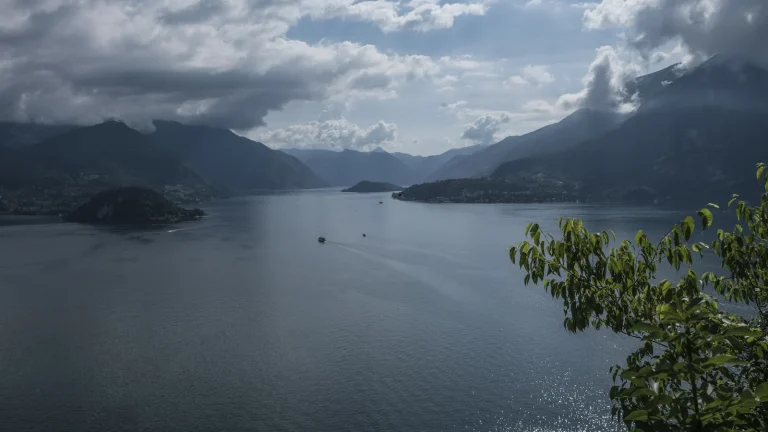
Lake Como is all about the ferry. You hop between villages, coffee on one shore, lunch on another, and the lake does the rest. It’s a huge Y-shaped lake, 146 km² and up to 46 km long, carved by a glacier, and at 425 m it’s one of the deepest lakes in Europe. Bellagio sits on the point where the two southern arms meet, with Varenna on the eastern shore and Menaggio on the western one, all linked by boat.
- How to get there: direct Trenord trains from Milano Centrale reach Varenna-Esino in about 64 minutes, with around 16 trains a day.
- Getting around: the lake ferries are run by Navigazione Laghi; the short central hops between Varenna, Bellagio, Menaggio and Cadenabbia are the ones you’ll use most. Buy tickets on land, because buying on board costs €1 extra.
- Swimming: yes, at lidos and public bathing spots in the villages.
- Best time: April to June and September. Mid-summer weekends are busy.
Como works as a day trip from Milan, but one night by the water makes it feel completely different. My other Italian favourites are in my guide to the best lakes in Italy.
4. Hallstätter See, Austria
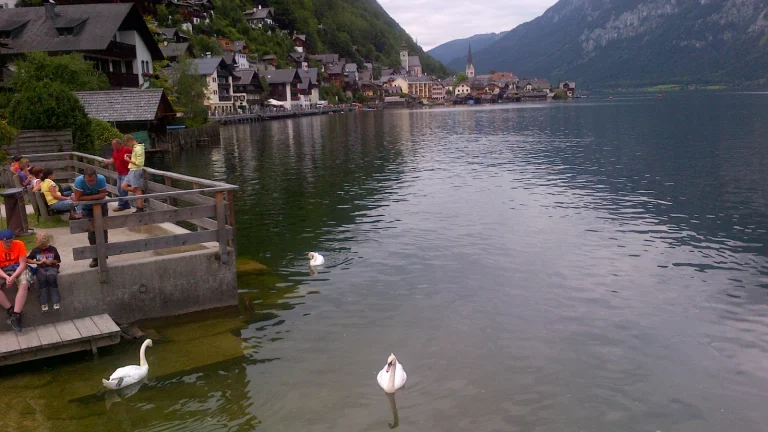
Hallstatt is beautiful and it is busy, and both things are true. The village climbs up the steep western shore of the Hallstätter See, a narrow lake about 5.9 km long and up to 125 m deep, with mountains dropping straight into it. My honest advice: sleep nearby and walk the village before 8:00 or after the coaches leave. That’s when it looks like the photos.
- How to get there: the train station is on the opposite shore; a small ferry meets the trains all year and takes you across to the village for €4 one way or €8 return, cash only.
- Salt mine and Skywalk: the funicular return is €29 and the salt mine tour with the funicular is €49 (checked November 2026). Both are closed from 7 to 29 January 2027.
- Swimming: check locally where bathing is allowed.
- Best time: any season if you’re there early; winter is quieter and the ferry still runs.
Hallstatt is an easy day from Salzburg. For more Austrian lakes, see my guide to the best lakes in Austria.
5. Lake Bohinj, Slovenia
If Bled is the postcard, Bohinj is the one people who know Slovenia quietly prefer. It’s the country’s largest permanent lake, 318 hectares, about 4.2 km long and up to 45 m deep, inside Triglav National Park. Fewer hotels, more forest. If I were planning Slovenia from scratch, this is where I’d spend a few slow days, and what I’d tell a friend is to combine it with Bled rather than choose.
- Savica waterfall: the walk to the lake’s main inflow costs €4 for visitors aged 16 and over; parking at P9 is €7 for up to 3 hours, card only. From 1 July to 31 August the road from Ukanc to the waterfall is closed to cars, and a summer bus runs from Bohinjska Bistrica.
- Panoramic boat: electric boats cross between Ribčev Laz and Ukanc in about 30 minutes; in 2026 a return cost €14 for adults. The boat is back on the lake from April 2027 (checked November 2026).
- Swimming: yes, but it’s a deep mountain lake, so expect cold water.
- Best time: June to September.
6. Oeschinensee, Switzerland
Switzerland has hundreds of lakes, and big ones like Lake Geneva get the attention. But the one I have firmly on my list is the Oeschinensee above Kandersteg: a turquoise alpine lake under a wall of cliffs. I haven’t been yet, so here’s what the official site says.
- How to get there: a gondola runs up from Kandersteg, and from the top station it’s about a 30-minute walk to the lake. From mid-June an electric taxi also runs roughly every half hour.
- Fee: a return was CHF 40 for adults in peak summer 2026 and CHF 36 in spring and autumn, half price with a Swiss Half Fare card (checked November 2026).
- Time slots: in summer and autumn you need a time slot for the ride up; book online and aim for before 9:00 or after 13:00.
- Season: summer 2027 runs daily from 24 April to 19 September, then autumn until 7 November.
- Swimming: check before you go; it’s a cold glacial lake.
Fares and slots are on the official Oeschinensee website.
7. Lake Ohrid, North Macedonia and Albania
Ohrid is the lake on this list I most want to see properly. It’s one of the oldest lakes in the world, with sediments that may be 3 to 5 million years old, and it’s huge: 358 km² and up to 288 m deep, shared between North Macedonia and Albania. More than 200 species living in it are found nowhere else. The town of Ohrid and the lake were listed by UNESCO from 1979, and the Albanian side was added in 2019.
What I’d tell a friend: base yourself in Ohrid town, give it at least two days, and make the trip to the St Naum monastery, near the springs that feed the lake.
- Getting there: Ohrid has its own airport; check seasonal flights, which change every year.
- Swimming: yes, in summer, from beaches along the shore.
- Best time: June to September for swimming; May and October for walking.
8. Sete Cidades, Azores, Portugal
The view from Vista do Rei on São Miguel is one of those I’d fly for again. Below you, in an almost circular volcanic crater about 6 by 5 km, lie two lakes of different colours: the Lagoa Azul and Lagoa Verde. Technically it’s one lake, 4.35 km² and up to 33 m deep, joined by a narrow strait with a bridge across it. The legend says they formed from the tears of a princess and a shepherd who weren’t allowed to marry, green for her eyes and blue for his.
- How to get there: by car on São Miguel; a rental car gives you the freedom to wait for the clouds to clear.
- The walk: the official PR3 SMI trail runs 7.7 km from Vista do Rei down to Sete Cidades village, about 2 hours. Part of it is steep, so take care on the descent.
- Fee: none for the viewpoints or the trail.
- Swimming: check before you go.
- Best time: any season, but only on a clear day. Check the forecast before you drive up; the crater fills with cloud fast.
For Lisbon, Porto and the islands, see my Portugal travel guide. The trail details are on the official Visit Azores trails site.
9. Lagos de Covadonga, Spain
Northern Spain is the green Spain most visitors never see, and the Lagos de Covadonga, Lago Enol and Lago Ercina, are its most famous view: two mountain lakes high in the Picos de Europa National Park, with green pastures around them and limestone peaks behind. On a clear day it feels more like the Alps than the Spain on postcards.
- How to get there: on busy days private cars are banned, and you take the bus from Cangas de Onís or the car parks along the road. In 2026 the restriction covered 1 June to 18 October plus Easter, May weekends and early December.
- Fee: the bus costs €9 for adults and €3.50 for children 4 to 11; parking is €3 per day (checked November 2026). Buy tickets in advance.
- Timetable: from late March to September the first bus leaves at 8:00 and the last one up at 17:45.
- Swimming: check before you go; it’s a protected national park.
- Best time: June to October, early in the day before the clouds roll in.
All my Spain city guides are on the Spain travel guide page. Access rules are on the official Asturias tourism website.
10. The Pliva lakes at Jajce, Bosnia and Herzegovina
This is my wildcard, and the one that surprises friends most. Just west of Jajce, the Pliva river forms two lakes held back by tufa barriers, with a row of about 20 tiny wooden watermills (Mlinčići) between them, most dating from Austro-Hungarian times. Then the river drops over a waterfall in the middle of town. Lakes, mills, a fortress and a waterfall in one easy day.
- How to get there: Jajce is about 2 hours’ drive northwest of Sarajevo; the mills are around 5 km west of town.
- Fee: the watermills are free, and the lower waterfall platforms cost about 10 KM.
- Swimming: yes, at the lake beach in summer.
- Best time: May to September.
Boračko, Prokoško and the heart-shaped Trnovačko jezero are in my full guide to the best lakes in Bosnia.
11. Lake Hévíz, Hungary
Hévíz is the only lake on this list I’d rather visit in winter. It’s a natural thermal lake of about 4.6 hectares, fed by a spring cave around 38 m down, and even on the coldest days the surface stays at about 24°C, rising to as much as 38°C in summer. Swimming in warm water while steam rises into cold air is the kind of thing you don’t forget.
- How to get there: Hévíz is about 8 km from Keszthely, at the western end of Lake Balaton.
- Fee: 3,000 HUF for an adult day ticket, 1,500 HUF for children 6 to 14; swim-ring rental is 700 HUF plus a cash deposit (checked November 2026).
- Winter hours: until 14 February 2027 bathing runs 9:00 to 16:00.
- Best time: November to March.
Balaton, Tata and the floating cabins of Bokod are in my guide to the best lakes in Hungary.
12. Lake Kournas, Crete, Greece
Kournas is a lovely break from Crete’s beaches. It’s the only natural freshwater lake on the island, between Chania and Rethymno, a few kilometres inland from the sea, with a perimeter of about 3.5 km and a maximum depth of 22.5 m. In winter it fills with mountain spring water; in summer the level drops and a sandy shore appears. It’s a Natura 2000 site with rare turtles, herons and cormorants.
- How to get there: about 47 km from Chania on the Chania–Rethymno road, or via Georgioupolis.
- Fee: none for the lake; pedal boats are rented from shops on the shore.
- Swimming: yes, the water is warm in summer.
- Best time: May to October. Go in the morning before tour groups.
Kournas fits into a day from Chania.
More lakes worth knowing about
Twelve is never enough. Three more from countries I’ve covered on the site:
- Windermere, UK: the largest lake in England, in the Lake District; see my UK travel guide.
- Uvac, Serbia: not one lake but a gorge of tight meanders, home to the largest griffon vulture colony in the Balkans; see my Serbia travel guide.
- Černé jezero, Czech Republic: the country’s largest and deepest natural lake, at 1,008 m in the Šumava forest near Železná Ruda; see my Czech Republic travel guide.
How to plan a European lakes trip
Several of these lakes link up naturally, so you don’t need to fly between all of them:
- Alpine loop (7 to 10 days): Lake Como → Switzerland and the Oeschinensee → Salzburg and Hallstatt → Bled and Bohinj → Plitvice.
- Balkans (7 days): Plitvice → Jajce and the Pliva lakes → Sarajevo → Ohrid, with Bosnia’s mountain lakes on the way.
- Central Europe (3 to 4 days): Budapest → Lake Balaton → Hévíz, then into Slovenia or Croatia.
- Separate trips: Sete Cidades, Covadonga and Kournas each pair best with their own region’s coast.
Best time to visit Europe’s lakes
For mountain lakes, June and September 2027 are the sweet spot: snow gone, warm enough to swim, but outside the August peak. Oeschinensee’s summer season runs from 24 April to 19 September 2027, Bohinj’s panoramic boat restarts in April, and the Covadonga bus system covers the busy months. Waterfall-fed lakes like Plitvice look best in May and June.
Winter has its own winners: Hévíz from November to March, and a calmer Hallstatt, where the ferry still runs. Just note that Hallstatt’s salt mine closes for most of January.
What to pack
- Swimwear and a quick-dry towel; many lakes are swimmable, but some are cold even in summer
- Shoes with grip for boardwalks, steep trails and wet rock
- Cash for small ferries and boats (the Hallstatt ferry is cash only) and a card for car parks that don’t take cash (like Savica)
- A warm layer; alpine lakes cool down fast once the sun goes
- A light rain jacket for the Azores and Asturias
Safety at Europe’s lakes
- Never swim where it’s banned, like anywhere in Plitvice Lakes National Park
- Alpine and glacial lakes are cold; get in slowly and stay close to the shore
- Watch the weather on mountain lakes and crater rims, where cloud and storms move in fast
- Stay on marked trails, especially on steep descents like the Vista do Rei path
Insider tips from travellers
- At the busiest lakes (Plitvice, Bled, Hallstatt, Oeschinensee), the tip that comes up again and again is the same: be there at opening time or stay until the evening.
- Book time slots online in summer for Plitvice and the Oeschinensee gondola; on-site slots sell out.
- Sleep by the lake, not in the nearest city; Hallstatt and Como feel different once the day-trippers leave.
- Check the forecast before driving up to Sete Cidades or Covadonga; a cloudy day means no view.
Heading further? Start with my country guides to the best lakes in Croatia, Italy, Austria, Bosnia and Hungary.
Europe lakes FAQ
What is the most beautiful lake in Europe?
There is no single answer, but Plitvice Lakes in Croatia, Lake Bled in Slovenia, Lake Como in Italy and the Hallstätter See in Austria are the ones that appear on almost every list. For something less crowded, try Lake Bohinj, Lake Ohrid or the Pliva lakes at Jajce in Bosnia.
Can you swim at Plitvice Lakes?
No. Swimming is banned everywhere in Plitvice Lakes National Park. If you want waterfalls and a swim on the same trip, look at the Pliva lakes in Bosnia or Lake Bled and Lake Bohinj in Slovenia.
How much does the boat to Bled Island cost?
A return pletna boat ride costs €20 per adult and €10 for children aged 4 to 12, and the island entrance ticket is €12 for adults. Prices were checked in November 2026.
Do you need to book the Oeschinensee gondola?
In summer and autumn a time slot is required for the ride up, and booking online in advance is recommended. A return cost CHF 40 for adults in peak summer 2026.
How do you get to Lake Como from Milan?
Direct Trenord trains from Milano Centrale reach Varenna-Esino in about 64 minutes, with around 16 trains a day. From Varenna, ferries cross to Bellagio and Menaggio.
Which European lake can you swim in during winter?
Lake Hévíz in Hungary. It is a natural thermal lake where the surface stays at about 24°C even on the coldest days, and the lake bath is open all winter.
What is the oldest lake in Europe?
Lake Ohrid, on the border of North Macedonia and Albania, is one of the oldest lakes in the world, with sediments that may be 3 to 5 million years old.
When is the best time to visit lakes in Europe?
June and September are the best overall, warm enough to swim but quieter than August. May and June are best for waterfall lakes like Plitvice, and November to March is best for Hévíz.
Cover photo: Canadianhockey91 / Wikimedia Commons (CC BY-SA 3.0) (source)

Written by
Miki Kokica
Travel blogger behind One Day Itinerary. I test every route myself and share honest, practical guides so you can plan better trips in less time.
Work with me Instagram